
Ai Content Generator
Ai Picture
Tell Your Story

 InVastor Academy Professionals
Module 4: AI for Grading, Assessment & Feedback Lesson 4.1: Automating Grading and Rubric-Based Evaluation
Module 4: AI for Grading, Assessment & Feedback
Lesson 4.1: Automating Grading and Rubric-Based Evaluation
Learning Objectives
By the end of this lesson, educators will be able to:
- Explain how AI can support grading and assessment processes.
- Use AI tools to evaluate student work using clear rubrics.
- Generate consistent, unbiased grading feedback using AI.
- Identify tasks AI can grade reliably vs. tasks requiring human review.
- Apply best practices for transparency and academic integrity in AI grading.
1. The Role of AI in Grading
AI tools can analyze student work, compare it to rubrics, and provide structured evaluation and feedback. These tools streamline repetitive grading tasks and reduce educator workload.
AI can currently assist well with:
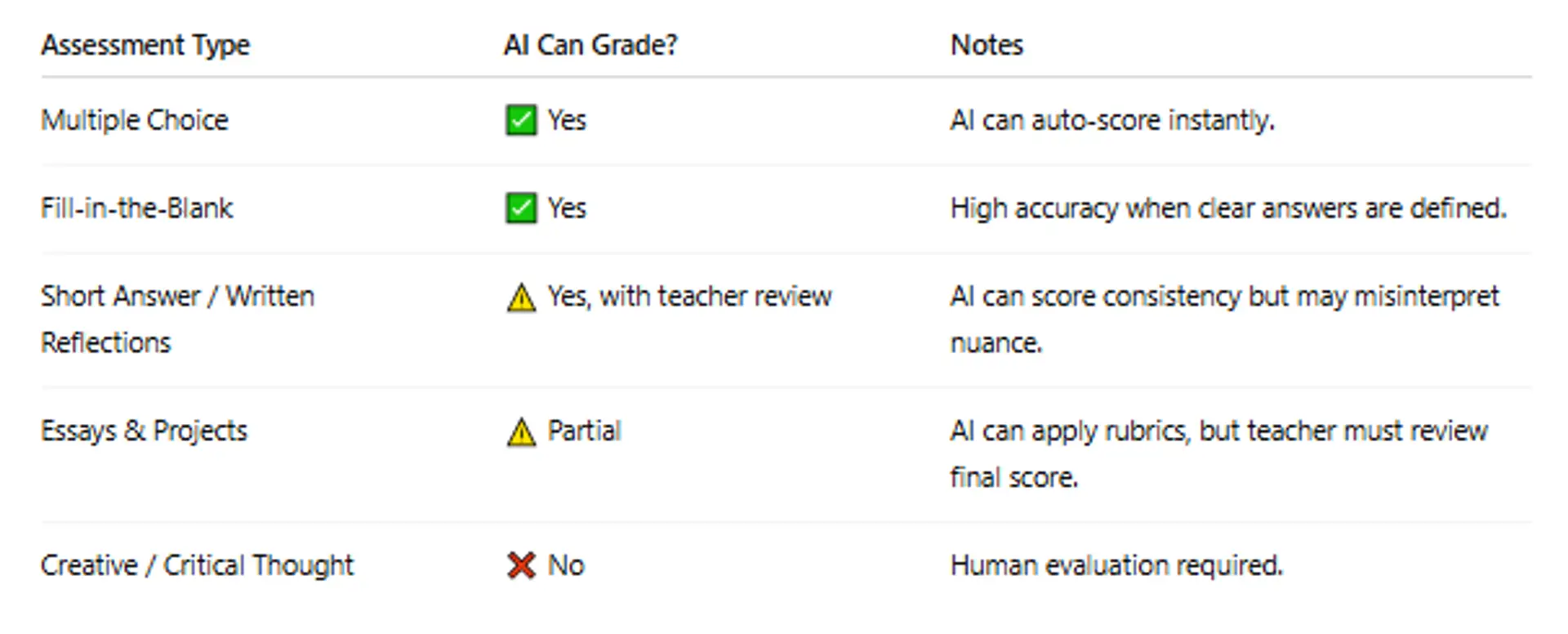
Key Principle:
AI speeds the process, but teachers maintain final judgment.
2.Rubric-Based Evaluation with AI
Rubrics make grading transparent, fair, and measurable.
AI can apply rubrics with impressive consistency — especially when the rubric is well-structured.
Example Rubric Criteria for Writing Assignment:
- Clarity of argument (0–4 points)
- Evidence and support (0–4 points)
- Structure & flow (0–3 points)
- Grammar & mechanics (0–3 points)
Using tools like:
- ChatGPT
- Gradescope
- Turnitin Draft Coach
- Google Classroom Rubrics
Educators can input the rubric and student response → AI returns scored criteria + feedback statements.
3. Example Prompt for AI Grading
Prompt Template:
You are helping me evaluate student submissions. Use the rubric below to score the response. Provide: (1) Score for each category, (2) Total Score, (3) Brief feedback. Do not rewrite the student’s work. Be fair, objective, and constructive.
Rubric:
[Paste Rubric]
Student Response:
[Paste Student Work]
This ensures transparency + fairness.
4. Benefits of AI Grading
✅ Faster grading turnaround
✅ Clearer, consistent scoring
✅ Reduces teacher workload
✅ Helps track learning progress over time
✅ Gives students immediate feedback to revise
5. Ethical & Practical Considerations
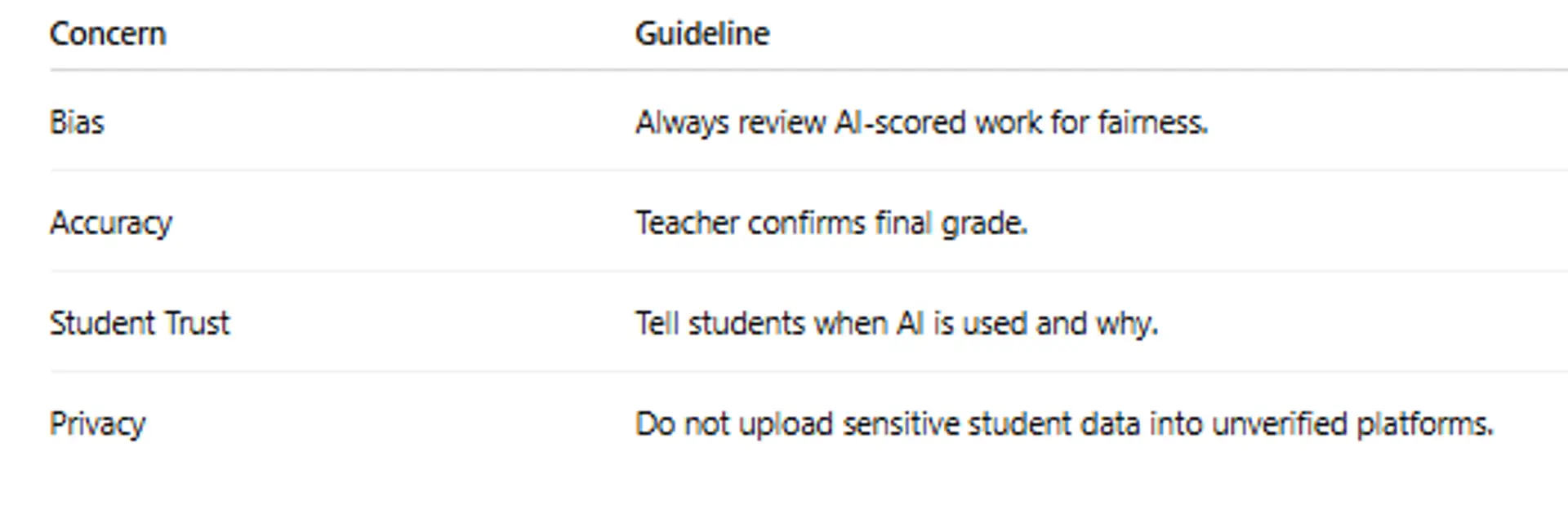
AI supports teachers — it does NOT replace evaluative judgment.
6. Key Takeaway
AI automates grading tasks and applies rubrics consistently, improving feedback quality and saving teacher time. However, teachers remain the final evaluators to ensure fairness, context, and human understanding.
7.Supplementary Resources
AI’s Impact on Teaching Practices - Automated Grading
Can AI Tools Be Used To Generate Effective Evaluation Rubrics? - Aspiring Teacher Guide
Tom's Takes: A Teacher's Guide to Grading with AI
Lesson 4.1 Quiz — Automating Grading & Rubric-Based Evaluation (10 Multiple Choice)
You must score at least 70% to pass.
This quiz counts toward your certification progress.
Click here for Quiz 4.1:
Conclusion
AI significantly enhances grading efficiency by applying rubrics consistently and providing immediate feedback. When educators maintain oversight and transparency, AI becomes a powerful partner, enabling more time for meaningful instruction, mentoring, and student support.
Next and Previous Lesson
Next: Module 4: AI for Grading, Assessment & Feedback
Lessons:
4.1: Automating Grading and Rubric-Based Evaluation
Related Posts
© 2026 Invastor. All Rights Reserved
User Comments