
Ai Content Generator
Ai Picture
Tell Your Story

 InVastor Academy Professionals
Module 1: Introduction to AI in Education Lesson 1.4: Case Studies — AI in Classrooms Around the World
Module 1: Introduction to AI in Education
Lesson 1.4: Case Studies — AI in Classrooms Around the World
Lesson Overview
Artificial Intelligence is not just a theory — it is already being used in schools across the world. This lesson explores real classroom implementations in different countries, focusing on what worked, what challenges teachers faced, and how students responded. By examining these case studies, educators can better understand practical strategies for meaningful AI integration.
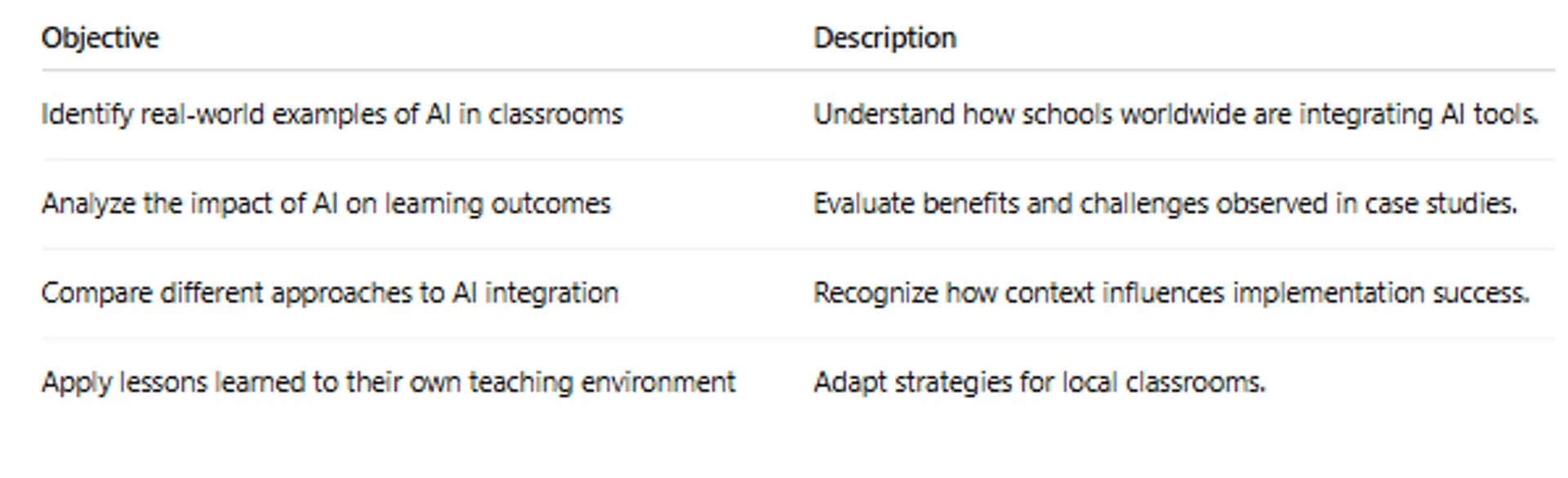
Learning Objectives
By the end of this lesson, educators will be able to:
1.Finland — AI for Personalized Learning and Student Autonomy
Context:
Finland’s education system emphasizes student independence and teacher facilitation.
AI Tool Used: Khanmigo (AI tutoring assistant by Khan Academy)
Implementation:
Students used Khanmigo to receive personalized math and science tutoring tailored to their performance level.
Outcome Highlights:
- Students progressed at their own pace
- Teachers gained insights from AI-generated learning analytics
- Classroom time shifted from lectures → discussion, problem-solving, and project collaboration
Challenge:
Some students initially relied too much on AI responses — requiring guidance on reflective learning.
Lesson Learned:
AI works best when teachers coach students to ask better questions, not just get answers.
2.China — Adaptive Learning Platforms at Scale
Context:
China has invested heavily in AI-powered learning platforms for large student populations.
AI Tool Used: Squirrel AI (Adaptive learning system)
Implementation:
Students completed lessons and quizzes that adjusted difficulty based on performance in real time. The system provided individual weakness reports.
Outcome Highlights:
- Struggling students improved 30–45% faster
- Teachers identified gaps more efficiently
- Students gained confidence through mastery-based pacing
Challenge:
High screen time required scheduling balance and parental involvement.
Lesson Learned:
AI should supplement — not dominate — face-to-face teaching.
3.United States — AI for Special Education Support
Context:
Schools serving neurodiverse learners needed tools to support communication and differentiated instruction.
AI Tools Used:
- Otter.ai (speech-to-text transcription)
- Speechify (text-to-speech reading support)
Implementation:
AI tools helped students with:
- Dyslexia
- Auditory processing challenges
- Attention and executive function needs
Outcome Highlights:
- Students gained greater independence in note-taking and reading
- Teachers could spend more time supporting cognitive skill-building
Challenge:
Some educators needed training to understand when assistive AI should be used and when students needed to be challenged without assistance.
Lesson Learned:
AI enhances accessibility but must be paired with proper instructional scaffolding.
4.India — AI Chatbots for Large Classrooms
Context:
Many Indian schools have large student-to-teacher ratios.
AI Tool Used: Chatbot Teaching Assistants (locally-built and WhatsApp-integrated bots)
Implementation:
Students asked homework questions to chatbots that explained concepts in English or regional languages.
Outcome Highlights:
- Students gained 24/7 academic support
- Students in rural regions gained access to quality learning explanations
- Teachers spent classroom time on higher-order teaching, not repetitive explanation
Challenge:
Teachers had to monitor chatbot accuracy to avoid misinformation.
Lesson Learned:
AI expands learning access, especially in underserved regions.
5.United Arab Emirates — AI for Competency-based Assessment
Context:
UAE’s national education strategy emphasizes preparing students for future digital economies.
AI Tool Used: AI-based student skill analytics
Implementation:
AI analyzed student project work, communication skills, and collaboration patterns to provide competency reports.
Outcome Highlights:
- Data supported personalized academic coaching
- Students could track their progress visually
- Teachers developed more targeted instructional interventions
Challenge:
Strong need for data privacy safeguards and secure systems.
Lesson Learned:
AI can support holistic student growth, not just test scores.
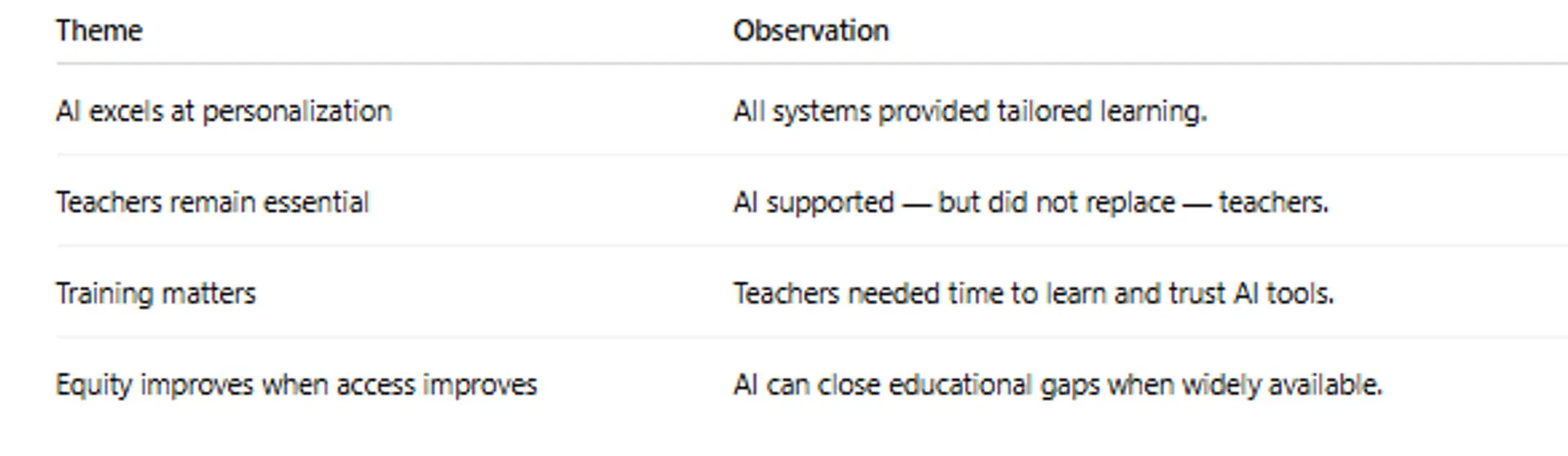
Key Themes Across Case Studies
Supplementary Resources
- AI in Education: Personalized Learning
- How Do Adaptive Learning Platforms Transform Education? - Safe AI for The Classroom
- Welcome to SpecialEdDocs | AI Tools & ChatGPT Tips for Special Education Teachers
Lesson 1.4 Quiz — Case Studies — AI in Classrooms Around the World
You must score at least 70% to pass.
Click here for Quiz 1.4:
Conclusion
AI in education is most effective when used to support, not replace, teachers. Global case studies show that AI increases personalization, accessibility, and learning efficiency when teachers guide responsible use and help students think critically.
Next and Previous Lesson
Next:Module 2: Personalized Learning with AI
Lessons:
2.1: Understanding Personalized Learning and Adaptive Education
Previous: Lesson 1.3: The Role of Educators in the AI Era
Learning Objectives
AI for Educators: Personalized Learning & Content Creation
Related Posts
© 2026 Invastor. All Rights Reserved
User Comments