
Ai Content Generator
Ai Picture
Tell Your Story


 InVastor Academy - (InVastor)
Module 6: Integration, Firm Governance, and Future Developments Lesson 6.1:
Module 6: Integration, Firm Governance, and Future Developments
Lesson 6.1: Implementing AI in Individual and Firm Practices
Learning Objectives
- Identify legal tasks and workflows where AI can be effectively integrated.
- Compare different types of AI tools used in legal practice (research, drafting, workflow automation, knowledge management, etc.).
- Develop strategies for adopting AI at both the individual practitioner and firm-wide levels.
- Establish governance frameworks to ensure responsible oversight, documentation, and risk mitigation.
- Evaluate vendor claims, pricing structures, data policies, and contract terms when selecting AI tools.
1.Understanding the Role of AI in Legal Practice
AI tools support, enhance, and accelerate legal work — but they do not replace professional judgment. In practice, AI is best used to:
- Automate repetitive work
- Accelerate legal research
- Improve drafting and review accuracy
- Enhance client communication and reporting
- Reduce administrative labor
Key Principle:
AI handles the pattern-recognition tasks; lawyers handle interpretation, judgment, and strategy.
2. Common Categories of Legal AI Tools
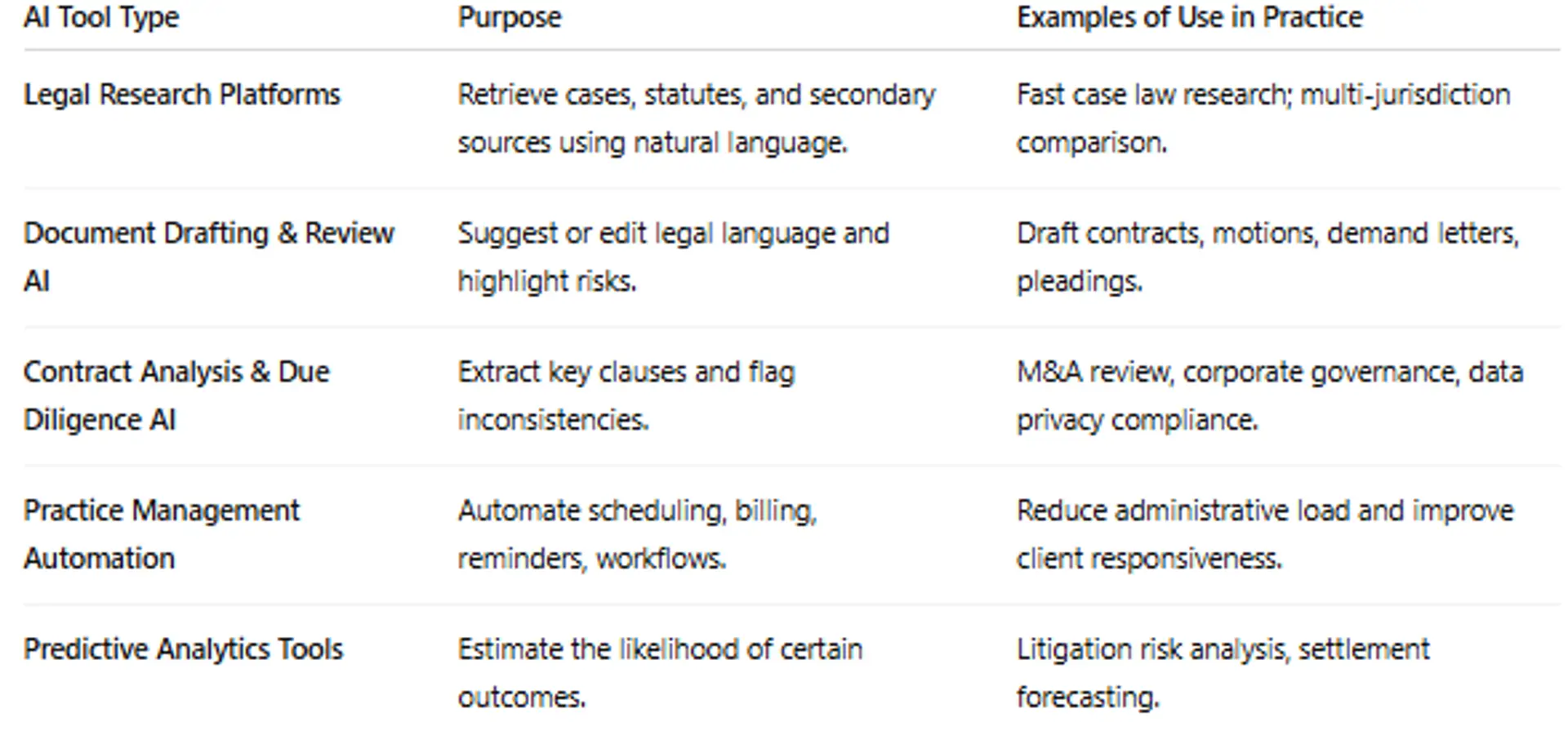
Selection should align with practice area needs. A solo immigration attorney has different needs than a large commercial litigation firm.
3. Stages of AI Adoption in a Law Firm
Implementing AI is a process, not a single purchase. It typically follows these phases:
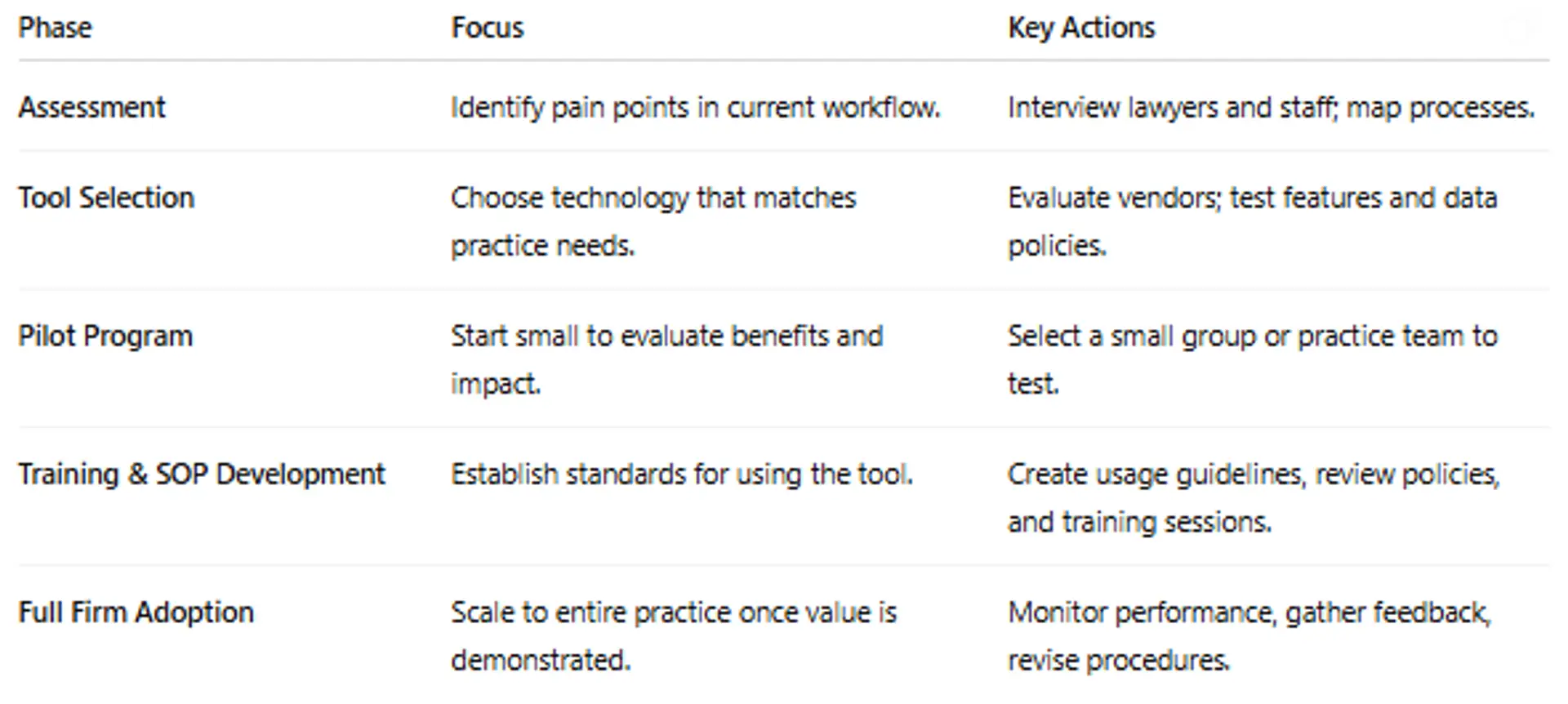
Important: Adoption is more success
ful when staff feel included and supported — not replaced.
4.Governance and Oversight
- To use AI responsibly, firms should establish clear internal policies covering:
- When and how AI tools may be used
- Required human review before delivering any AI-generated work product
- Data privacy and client confidentiality controls
- Vendor data retention & access restrictions
- Training and periodic proficiency verification
Suggested Policy Statement:
“AI-generated content must be reviewed by a licensed attorney before being shared with a client, opposing counsel, or the court.”
5.Vendor Evaluation Checklist
When evaluating any legal AI provider, ask:
- What data is the system trained on?
- Does any client data leave the firm environment?
- Does the tool store or learn from confidential materials?
- How is model accuracy measured and communicated?
- Is there an audit trail?
- Can outputs be explained, not just provided?
- What is the total cost of ownership?
Firms should never rely solely on vendor marketing claims.
Supplementary Resources
- How AI Breakout Harvey is Transforming Legal Services, with CEO Winston Weinberg
- I’m Begging You, Stop Hiring AI Lawyers.
- Top 4 AI Legal Tools Revolutionizing 2025 | The Future of Legal Tech
Lesson 6.1 Quiz — Implementing AI in Individual and Firm Practices (8 Multiple Choice)
Please complete this quiz to check your understanding of Lesson 6.1.
You must score at least 70% to pass.
This quiz counts toward your final certification progress.
Click here for Quiz 6.1:
Conclusion
AI can significantly enhance legal practice when deployed strategically and responsibly. Effective integration requires understanding use cases, selecting the right tools, establishing governance policies, and maintaining consistent human oversight. Firms that adopt AI thoughtfully can improve efficiency, reduce costs, and increase client value — while preserving the core professional responsibilities of judgment, advocacy, and ethical practice.
Next and Previous Lesson
Lesson 6.2: Drafting AI Use Policies and Client Disclosures
Previous:Lesson 5.3: Bias, Fairness, and Reliability in Legal AI
Related Posts
© 2025 Invastor. All Rights Reserved
User Comments