
Ai Content Generator
Ai Picture
Tell Your Story

 InVastor Academy - (InVastor)
Module 4: AI-Supported Legal Drafting Lesson 4.2: Contract Drafting, Analysis, and Revision
Module 4: AI-Supported Legal Drafting
Lesson 4.2: Contract Drafting, Analysis, and Revision
Learning Objectives
- Explain how AI can be used responsibly in contract drafting and review.
- Apply structured prompting to generate accurate contract language.
- Analyze contract clauses for ambiguity, risk, and enforceability using AI support.
- Revise and redline contract language while maintaining legal accuracy.
- Identify confidentiality and verification requirements when using AI for sensitive contract matters.
AI has become a valuable tool for contract drafting and analysis. It can help lawyers structure agreements, compare clauses, simplify language, and identify risk. However, AI does not replace the attorney’s legal judgment, negotiation experience, or business reasoning.
To use AI effectively, the lawyer must control the inputs, verify the outputs, and advise clients based on professional skill—not AI inference.
1.How AI Assists in Contract Drafting
AI can:
- Generate contract templates tailored to specific deal types.
- Suggest alternative or industry-standard clauses.
- Rephrase contract language for readability.
- Identify missing required components (boilerplate, definitions, jurisdiction).
- Detect inconsistent terminology across the document.
AI increases drafting efficiency but final structure and enforceability require
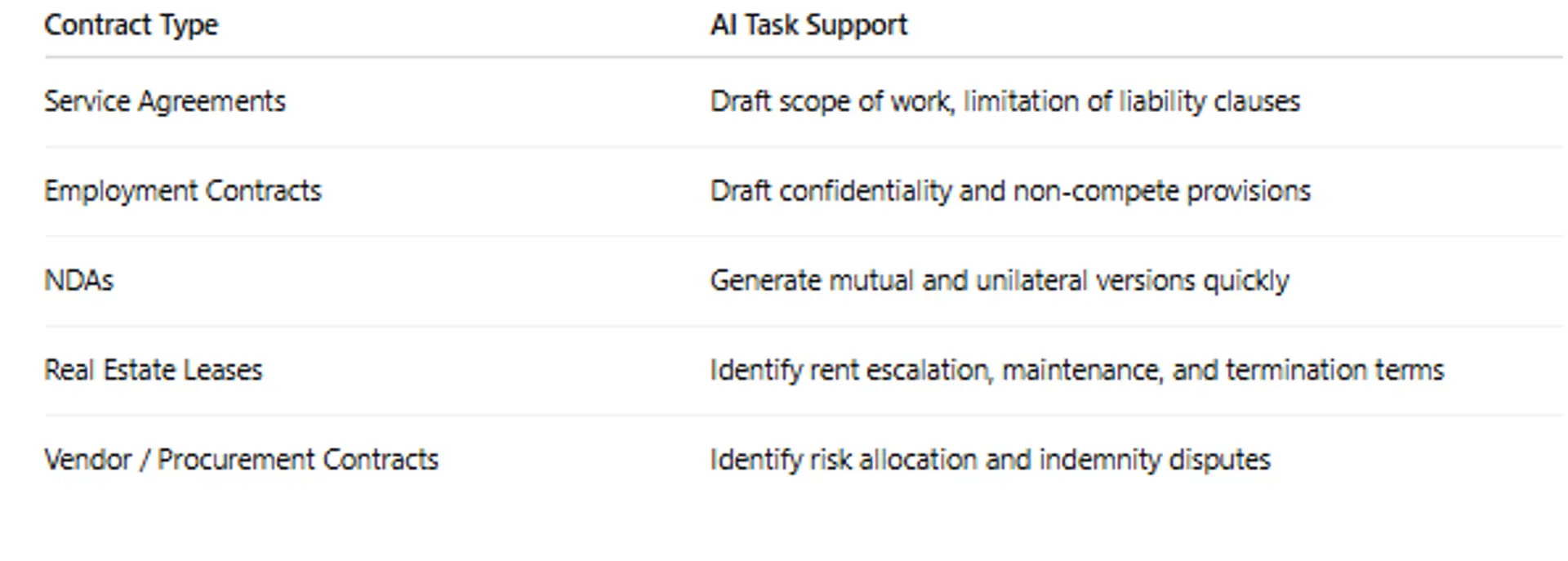
2. Types of Contracts Commonly Drafted with AI Assistance
3. Core Structural Elements of a Contract
A valid contract generally contains:
- Parties (Defined clearly)
- Recitals / Purpose
- Definitions
- Main Obligations of Each Party
- Payment Terms
- Intellectual Property or Confidentiality Terms (if applicable)
- Representations and Warranties
- Indemnification
- Limitation of Liability
- Term and Termination
- Governing Law and Venue
- Signatures / Execution Blocks
AI can generate or refine any section—but the lawyer ensures legal enforceability.
4. Prompting AI to Draft a Contract
Example Prompt:
Draft a service agreement between a marketing consultant and a small business.
Include:
- Scope of Services
- Payment Terms
- Confidentiality
- Term and Termination
- Limitation of Liability
Use clear and professional commercial contract language.
Do not create any names; use placeholders instead.
5.Using AI to Improve Clarity and Reduce Ambiguity
You can instruct AI to:
- Simplify complex passages
- Convert legalese into plain, client-friendly language
- Highlight unclear or conflicting clauses
Example Prompt:
Rewrite the following clause for clarity while preserving its legal meaning:
[Insert Clause]
6.AI-Supported Contract Risk Analysis
Ask AI to analyze a contract section-by-section:
Review the contract text below and identify:
- Ambiguous terms
- Imbalanced risk allocation
- Missing essential clauses
- Points requiring client negotiation
Explain findings in bullet points.
Do not rewrite the contract unless instructed.
The lawyer must evaluate whether the identified risks are commercially acceptable.
7. Redlining and Revision Using AI
AI can suggest redlines, but lawyers must approve the changes.
Example Prompt:
Compare Version A and Version B of the contract text below.
Highlight:
- Additions
- Deletions
- Modified clauses
Provide a clean redline summary and indicate potential negotiation concerns.
8.Ethical & Confidentiality Considerations
- Remove client names, company names, and deal numbers when using public AI tools.
- Do not upload full negotiation drafts without anonymization.
- Always verify enforceability under local jurisdiction laws.
- Use enterprise/private AI for high-value or sensitive agreements.
9.Supplementary Learning Resources
Videos:
- Two AI Tools to Simplify Contract Review
- AI Revolution: Uncovering Risky Contract Clauses with ContractNerd
- AI Drafting Assistant for Contracts
Lesson 4.2 Quiz
Contract Drafting, Analysis, and Revision
Please complete this quiz to check your understanding of Lesson 4.2.
You must score at least 70% to pass.
This quiz counts toward your final certification progress.
Click here for Quiz 4.2
Conclusion
AI significantly improves efficiency in contract drafting, review, and negotiation preparation, but it must be used responsibly. Lawyers must continue to apply independent legal judgment, verify outcomes, and ensure clarity, fairness, and enforceability of contract terms. When applied properly, AI strengthens legal precision and speeds up document workflows without compromising professional standards.
Next and Previous Lesson
Lesson 4.3: Litigation Analysis and Strategy Development
Previous :Lesson 4.1: AI-Assisted Memoranda and Brief Writing
Related Posts
© 2025 Invastor. All Rights Reserved
User Comments