
Ai Content Generator
Ai Picture
Tell Your Story

 InVastor Academy - (InVastor)
Module 3: Legal Research and Case Law Verification Lesson 3.1 – Conducting AI-Supported Legal Research Correctly
Module 3: Legal Research and Case Law Verification
Lesson 3.1 – Conducting AI-Supported Legal Research Correctly
Learning Objectives
- By the end of this lesson, the learner should be able to:
- Explain how AI can assist in the legal research process responsibly.
- Identify the limitations and risks of relying on AI-generated legal content.
- Apply proper verification techniques to confirm the accuracy of AI-sourced information.
- Recognize when human judgment and trusted databases must override AI suggestions.
- Use free and paid legal research tools effectively (Google Scholar, Westlaw, LexisNexis).
Artificial Intelligence (AI) has transformed the way lawyers perform legal research. Tools like ChatGPT, Westlaw Edge, Lexis+, and even free resources such as Google Scholar can summarize case law, generate search queries, and identify relevant precedents in seconds. However, AI does not replace authoritative research — it only accelerates it.
1.The Role of AI in Legal Research
AI tools analyze patterns across massive databases to generate possible cases, statutes, and arguments.
They can help you:
- Create targeted search queries (“Find cases discussing negligence and duty of care in medical malpractice”).
- Summarize long judicial opinions.
- Identify key issues and precedent patterns.
- Suggest potential arguments or analogies.
But AI tools also have a fundamental limitation: they do not access real-time legal databases unless integrated with them.
ChatGPT, for example, does not have inherent access to Westlaw or LexisNexis unless specifically connected via secure APIs.
2. The Risk of AI “Hallucinations” in Legal Research
A 2024 Oxford Journal of Legal Analysis study found that large language models “hallucinate” legal citations in over 50% of outputs when asked to produce case law references.
Stanford University’s “AI on Trial” report (2024) similarly found that one in six legal queries produced a false citation or misrepresented holding.
Case Example: Mata v. Avianca, Inc. (2023)
Attorneys filed a legal brief with fabricated case citations generated by ChatGPT. The court discovered that these cases didn’t exist.
Result: The lawyers were sanctioned and publicly reprimanded.
Lesson:
Never copy case citations or summaries from AI directly into a brief or memo without manual verification.
3.Proper Workflow for AI-Supported Research
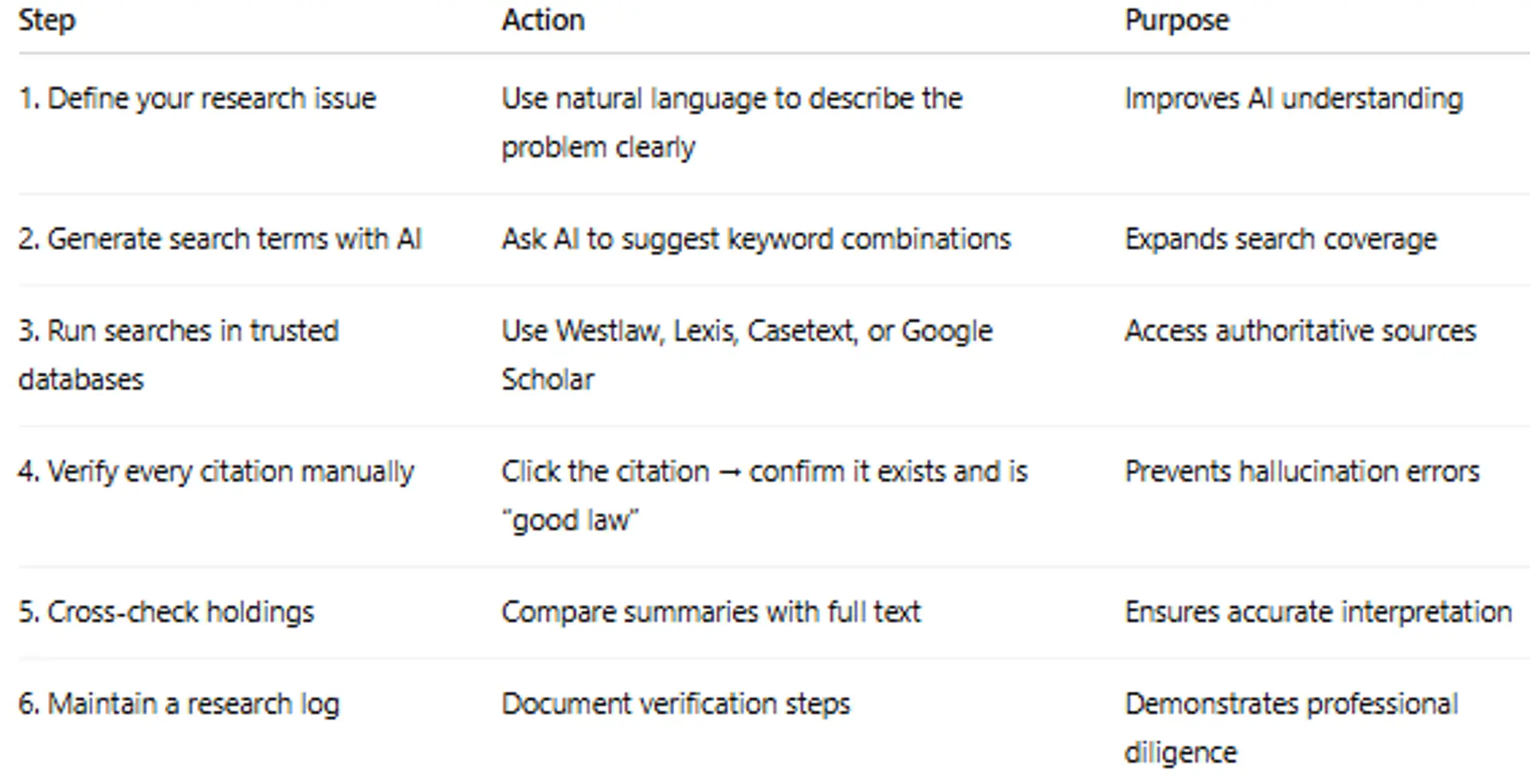
4.Tools for Verifying Case Law Accuracy
1.Westlaw (KeyCite):
Flags negative treatment (red flag = overruled, yellow flag = caution).
Westlaw Tip: Checking Cases with KeyCite
2.LexisNexis (Shepard’s):
Uses colored signals to indicate case treatment — red, orange, yellow, or green.
Green means good law; red means overruled.
3.Google Scholar:
Free but limited. You can check the “Cited by” link to see how many later cases referenced your case — a helpful way to gauge continuing authority.
Library of Congress Guide: How to Find Case Law with Google Scholar
4.Casetext CoCounsel (AI-Enhanced):
Uses generative AI but sources from verified case law databases.
5. Verification Checklist Before Relying on AI Research
- All case citations confirmed via official source.
- Summaries reviewed against full case text.
- No confidential facts entered into public AI.
- AI output stored securely or anonymized.
- Record of verification steps maintained.
Failure to perform these checks may breach Model Rule 1.1 (Competence) and Model Rule 3.3 (Candor to the Tribunal).
6. When to Rely on AI – and When Not To
Effective Uses:
- Brainstorming issues and arguments.
- Generating keyword suggestions.
- Simplifying complex case summaries.
Avoid Using AI:
- For direct citation generation.
- For statutory interpretation without human review.
- When drafting materials intended for court submission.
7. Best Practice Example
If AI produces this citation:
“Smith v. Green, 2020 U.S. Dist. LEXIS 45321 (D. Mass. 2020)”
You must:
- Paste it into Google Scholar → confirm it exists.
- Check the “Cited by” section.
- Open full text → confirm the holding matches the AI summary.
- If not, delete or correct the reference.
8.Supplementary Learning Resources
Video Resource:
- Legal Research Tutorial: Finding Case Law Using Google Scholar
- 03.01 - Introduction to Legal Research: Thinking Through a Legal Problem
- LAW SCHOOL | How to do Legal Research
Lesson 3.1 Quiz
Conducting AI-Supported Legal Research Correctly
Please complete this quiz to check your understanding of Lesson 3.1.
You must score at least 70% to pass this lesson quiz.
This quiz counts toward your final certification progress.
Click here for Quiz 3.1
Conclusion
AI is a powerful research assistant — but it is only reliable when used responsibly. It can speed up the process of identifying relevant laws and jurisprudence, but the researcher must always verify every case, statute, or legal principle using official sources. Mastering AI-assisted legal research is not just about knowing how to ask the right questions — it is about developing disciplined habits of checking, confirming, and thinking critically.
AI Helps You Research Faster — But You Ensure the Research Is Correct.
Next and Previous Lesson
Lesson 3.2: Preventing and Detecting AI-Created Citations
Previous : Lesson 2.3 – Workflow Templates for Legal Tasks
Related Posts
© 2025 Invastor. All Rights Reserved
User Comments