
Ai Content Generator
Ai Picture
Tell Your Story

 InVastor Academy - (InVastor)
Module 2: Prompt Engineering for Legal Analysis Lesson 2.2 – Multi-Step Reasoning Prompts for Legal Argument
Module 2: Prompt Engineering for Legal Analysis
Lesson 2.2 – Multi-Step Reasoning Prompts for Legal Argument
Learning Objectives
- Understand what multi-step reasoning is and why it matters in legal analysis.
- Construct prompts that guide AI to break down legal issues in logical stages.
- Use structured reasoning formats (IRAC, CREAC, TREAT, Rule Synthesis, etc.) in prompts.
- Instruct AI to consider multiple perspectives, opposing arguments, and counter-arguments.
- Apply multi-step prompts to strengthen legal argument drafting, research analysis, and client communication.
AI does not inherently reason like a lawyer. It predicts likely language patterns. To get analytical, structured, and persuasive legal argumentation, the lawyer must guide the reasoning process step-by-step. This is where Multi-Step Reasoning Prompts become essential.
These prompts break a legal task into stages:
- Identify legal issues
- Determine relevant legal rules
- Apply rules to facts
- Evaluate strengths and weaknesses
- Address counterarguments
- Produce a reasoned legal conclusion
This transforms AI output from generic summaries into well-developed legal reasoning.
1.Why Multi-Step Reasoning Is Necessary
Without structured reasoning prompts, AI may:
- Provide surface-level conclusions without explanation.
- Skip relevant law.
- Overstate or generalize legal principles.
- Provide inaccurate assumptions.
Multi-step prompts force the AI to “think aloud” and produce traceable reasoning, similar to how lawyers are trained.
2. Recommended Legal Reasoning Structures
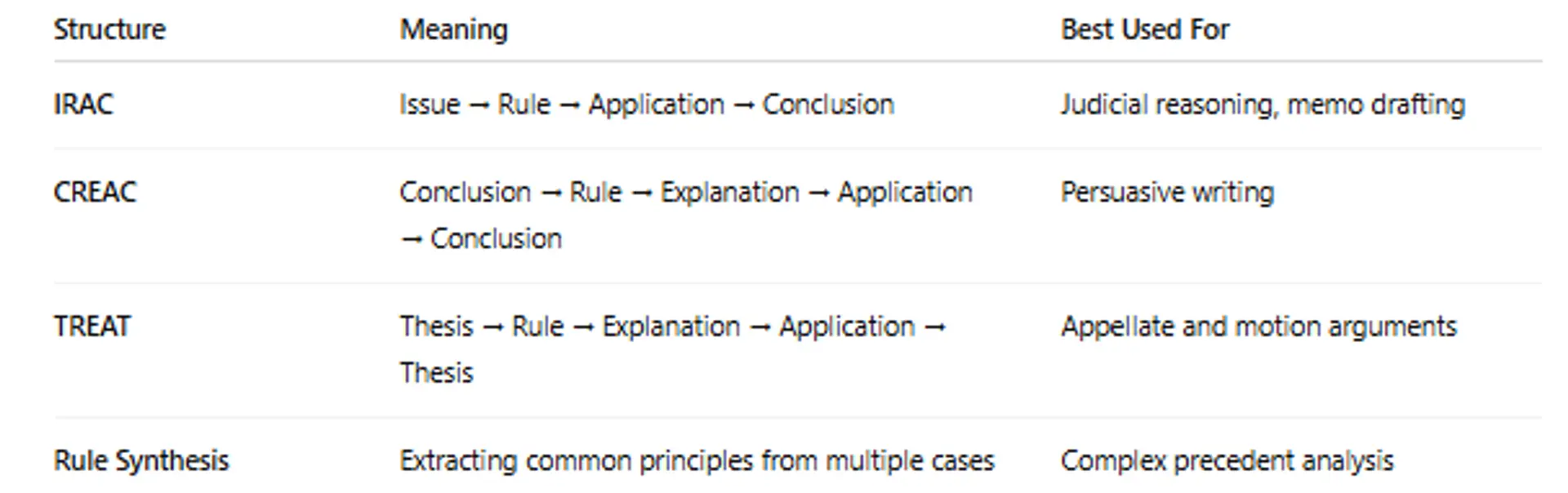
Your prompt should tell the AI which structure to use.
3.Example of a Weak Prompt vs. Strong Multi-Step Prompt
Weak Prompt:
“Write a legal argument for a breach of contract case.”
Strong Multi-Step Reasoning Prompt:
Act as a legal analyst. Use the IRAC structure.
Facts: The defendant agreed in writing to deliver 500 units of equipment by July 1. Delivery occurred on August 10. The delay caused the plaintiff $45,000 in business losses.
Task:
- Identify the legal issue.
- State the governing contract law rule.
- Apply the rule to the facts.
- Provide a well-reasoned conclusion.
Present the answer in clear paragraphs.
4. Adding Opposing Argument and Rebuttal
To deepen analysis, add:
Then provide a section titled “Defendant’s Argument” presenting the strongest defense argument, and a section titled “Plaintiff’s Rebuttal” responding to that defense.
5.Prompt Template for Multi-Step Legal Argument
Act as a legal research and writing assistant.
Context: [Describe legal scenario]
Jurisdiction: [Specify state/federal court]
Task:
• Identify the issue(s)
• State the relevant rule(s) with statutory or case reference placeholders
• Apply the rule(s) to the facts
• Provide a conclusion
• Present a strong opposing argument
• Provide a rebuttal to the opposing argument
Format using IRAC/CREAC/TREAT (choose one).
6. Example Output Structure (IRAC)
Issue: What is the disputed legal question?
Rule: What law applies?
Application: How does the law apply to the specific facts?
Conclusion: The likely outcome or argument position.
7.Critical Reminder: Verification Required
Even well-reasoned AI arguments may contain:
- Incorrect case names
- Non-existent citations
- Misinterpretation of statutory language
Always verify using:
- Westlaw
- LexisNexis
- Casetext
- Court/Statutory Sources
8.Supplementary Learning Resource
Video:
- How to Argue Like a Lawyer (and WIN) with 4-Step Formula
- Legal Reasoning Is Multifaceted | Logic for Lawyers: Crafting Persuasive Legal Arguments Part 1 of 6
- Q&As | Logic for Lawyers: Crafting Persuasive Legal Arguments Part 6 of 6
Lesson 2.2 Quiz
Structuring Clear and Effective Legal Prompts
Please complete this quiz to check your understanding of Lesson 2.2. You must score at least 70% to pass this lesson quiz. This quiz counts toward your final certification progress.
Conclusion
Multi-step reasoning prompts elevate AI from simple drafting assistance to serious legal argument development. By instructing AI to follow structured reasoning frameworks and requiring opposing viewpoints, attorneys ensure stronger, clearer, and more credible legal work. The lawyer remains the evaluator, but AI becomes a powerful analytical partner when guided methodically.
In the next lesson, we will learn how to use case-based prompting and precedent synthesis to deepen research reliability.
Next and Previous Lesson
Lesson 2.3: Workflow Templates for Legal Tasks
Previous:Lesson 2.1 – Structuring Clear and Effective Legal Prompts
Related Posts
© 2025 Invastor. All Rights Reserved
User Comments