
Ai Content Generator
Ai Picture
Tell Your Story

 InVastor Academy - (InVastor)
Module 1: Foundations of Legal AI and ChatGPT Lesson 1.3 – Ethical Use of AI in Legal Practice
Module 1: Foundations of Legal AI and ChatGPT
Lesson 1.3 – Ethical Use of AI in Legal Practice
Learning Objectives
- Explain how core ethical duties apply to AI-assisted legal work.
- Identify what types of data may and may not be entered into AI tools.
- Describe why verification of AI output is required under professional conduct rules.
- Recognize where legal reasoning and decision-making must remain human-led.
- Apply practical procedures to use AI in a responsible, defensible, and client-protective manner.
AI is now integrated into legal workflows across firms of all sizes. However, improper use can lead to malpractice claims, disciplinary action, privilege waiver, client harm, and judicial sanctions.
Therefore, lawyers must understand how ethical rules apply specifically to AI.
This lesson organizes AI ethics under five core duties recognized across jurisdictions
- Duty of Competence
- Duty of Confidentiality
- Duty of Independent Judgment
- Duty of Candor to the Court
- Duty to Supervise
1. Duty of Competence (Model Rule 1.1)
Competence now includes technological literacy.
The ABA states that lawyers must:
“Keep abreast of changes in the law and its practice, including the benefits and risks associated with relevant technology.”
This means:
- A lawyer MUST know what AI can and cannot do
- A lawyer MUST evaluate whether an AI tool is appropriate for a task
- A lawyer MUST review everything AI produces before using it
Example:
If AI summarizes a case incorrectly and the lawyer relies on it without verifying:
- The lawyer violates competence
- The lawyer may cause client harm and incur liability
Competence is not about knowing how to build AI — it is about knowing how to use it responsibly.
2.Duty of Confidentiality (Model Rule 1.6)
Many AI tools send user input to external servers. This means:
- Client names
- Witness names
- Medical conditions
- Financial records
- Case strategy discussions
- Privileged correspondence
cannot be entered into public AI tools.
Only input anonymized, non-identifying versions of facts.

Some law firms now use private, encrypted enterprise AI systems, which may permit confidential input.
If using standard public ChatGPT / Claude / Gemini → treat it like speaking in a public hallway.
Confidentiality violations can:
- Waive attorney–client privilege
- Trigger malpractice claims
- Violate regulatory privacy laws (HIPAA, GDPR, CCPA)
3.Duty of Verification (Model Rules 1.1, 3.3, 5.3)
AI is known to sometimes produce:
- Incorrect statements of law
- Case law that sounds real but does not exist (hallucinations)
- Misquoted holdings and dicta
- Outdated statute versions
All legal assertions generated by AI must be checked manually using trusted legal research tools.
Case Example:
In Mata v. Avianca (2023), lawyers submitted a brief containing AI-invented cases.
The court sanctioned them and required public admission of misconduct.
Key Rule:
If you cannot personally verify a citation → you cannot rely on AI to have done so.
4.Duty of Independent Professional Judgment (Model Rule 2.1)
AI cannot:
- Weigh case strategy
- Evaluate litigation risk
- Understand client priorities
- Decide negotiation positioning
Legal decisions must come from the attorney, not the AI.
AI provides:
- Structure
- Clarification
- Brainstorming
- Efficiency
The lawyer provides:
- Interpretation
- Advocacy
- Analysis
- Strategy
AI supports thinking, but does not replace reasoning.
5.Duty of Candor to the Court (Model Rule 3.3)
Submitting unverifiable, inaccurate, or fabricated legal authority is considered:
- Misrepresentation to the tribunal
- A breach of candor
- Grounds for discipline
Before filing any AI-assisted document:
- Verify citations manually
- Confirm quotations from original sources
- Rewrite portions requiring legal reasoning
When in doubt, err on the side of under-use rather than over-reliance.
6.Duty to Supervise Non-Lawyers (Model Rule 5.3)
Ethics rules treat AI tools similarly to:
- Paralegals
- Law clerks
- Staff researchers
The lawyer is responsible for:
- The output created
- The conclusions drawn from it
- The accuracy and ethical compliance of all work produced
A lawyer cannot defend misconduct by saying:
“The AI wrote it, not me.”
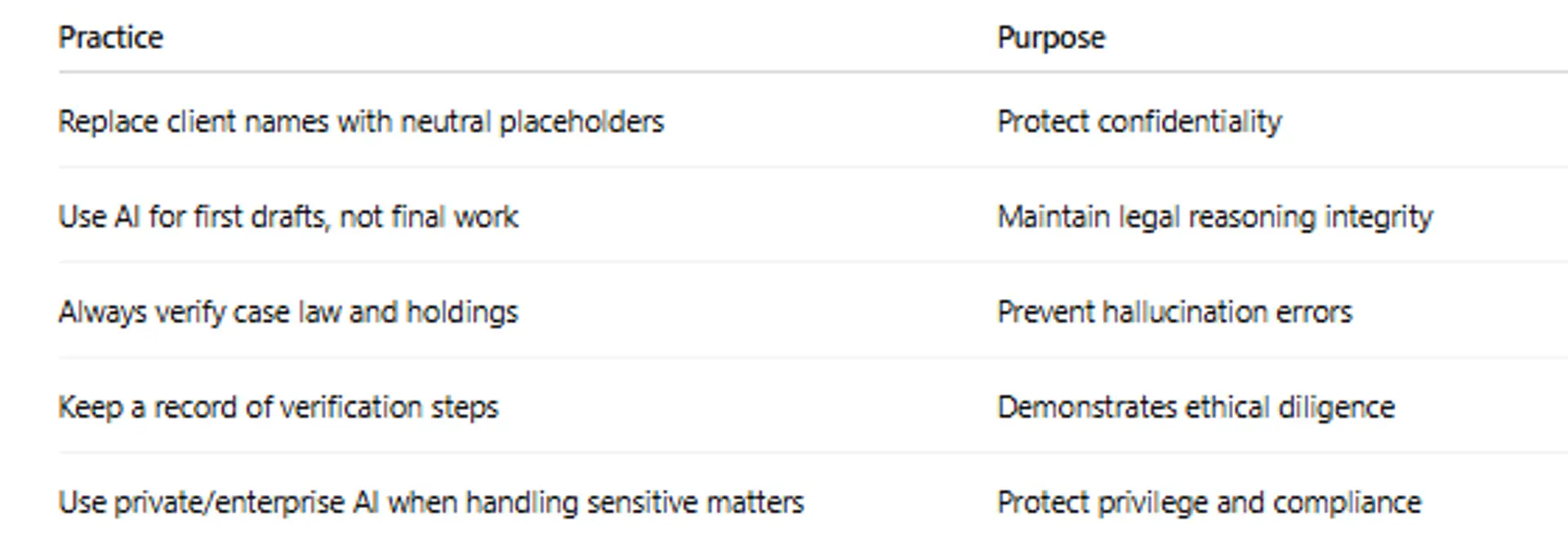
7. Recommended Safe Use Practices
8.When AI Should Not Be Used
- When dealing with privileged case strategy
- When analyzing unsettled or highly fact-specific legal issues
- When drafting documents intended for immediate filing without human revision
- When conducting legal interpretation that requires precedent-based reasoning
9.When AI Use is Particularly Effective
- Drafting client-facing explanations in plain language
- Summarizing long transcripts or reports
- Creating document structure and outline templates
- Brainstorming alternative arguments or approaches
- Rewriting text for clarity and tone
AI increases efficiency — the lawyer maintains authority and judgment.
10.Supplementary Learning Resource
Video: AI Ethics for Lawyers – Understanding Risk, Responsibility, and Best Practices
AI for Lawyers: Navigating Ethics & Best Practices | Justia Webinars
Ethical AI in Law Safeguarding Client Data & Avoiding Misuse
What is Responsible AI? A Guide to AI Governance
Lesson Quiz 1.3
Please complete this quiz to check your understanding of the lesson. You must score at least 70% to pass this lesson quiz. This quiz counts toward your final certification progress.
Answer the quiz using the Google Form below.
Conclusion
Ethical AI use in law is not optional — it is required.
Every AI-assisted output must be verified, anonymized, supervised, and judged by the attorney.
AI is a tool that improves clarity and efficiency, but only responsible use preserves client trust, legal accuracy, and professional integrity.
In the next lesson, we will begin hands-on prompting techniques to apply AI safely and strategically.
Next and Previous Lesson
Module 2: Prompt Engineering for Legal Analysis
Lesson 2.1: Structuring Clear and Effective Legal Prompts
Previous: Lesson 1.2 — Understanding ChatGPT and Legal Use Cases
Related Posts
© 2025 Invastor. All Rights Reserved
User Comments