
Ai Content Generator
Ai Picture
Tell Your Story

 InVastor Academy - (InVastor)
Module 1: Foundations of Legal AI and ChatGPT, Lesson 1.1: What AI Is and How It Works in Legal Contexts
Module 1: Foundations of Legal AI and ChatGPT
Lesson 1.1: What AI Is and How It Works in Legal Contexts
Lesson Objectives
By the end of this lesson, the participant will be able to:
- Define the basic architecture and operational concept of Large Language Models (LLMs).
- Distinguish generative AI (e.g., ChatGPT) from search engines and legal databases.
- Identify core capabilities and limitations of LLMs in legal tasks.
- Apply a short checklist to determine when an LLM may or may not be appropriate for a legal task.
1. What is a Large Language Model (LLM)?
- LLMs are neural network models trained on extremely large text datasets.
- They generate text by predicting the most likely next words based on patterns learned during training.
- They do not pull answers directly from law books or databases; they generate synthetic text approximating what a legal answer should sound like.
This means:
- Fluent output ≠ Verified law
- Accuracy requires independent confirmation
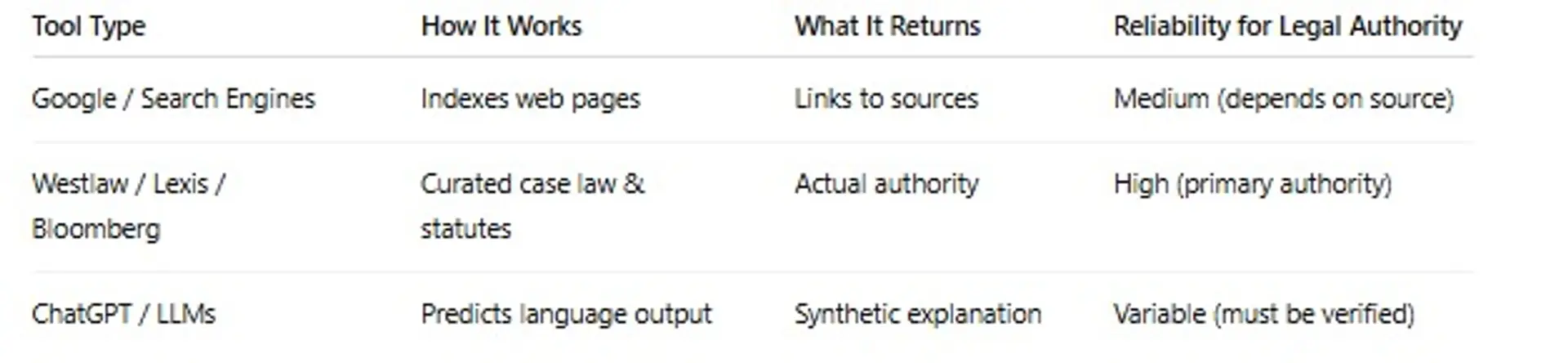
2. How LLMs Differ From Legal Databases & Traditional Search
Key principle:
LLMs draft. Legal databases verify. Both are required.
3. Useful Capabilities of LLMs in Legal Work
LLMs can:
- Summarize lengthy documents quickly
- Draft first versions of memos, briefs, letters, and arguments
- Generate case issue outlines and counterarguments
- Suggest clause variations in contract drafting
Effective use case:
Use LLMs to produce structured first drafts. Then refine, verify, and finalize manually.
4. Core Limitations: Hallucination and Authority Risk
- Hallucination: When the model creates a case, quote, or statute that sounds real but is not real.
- This risk exists because LLMs generate plausible language, not confirmed references.
Professional rule:
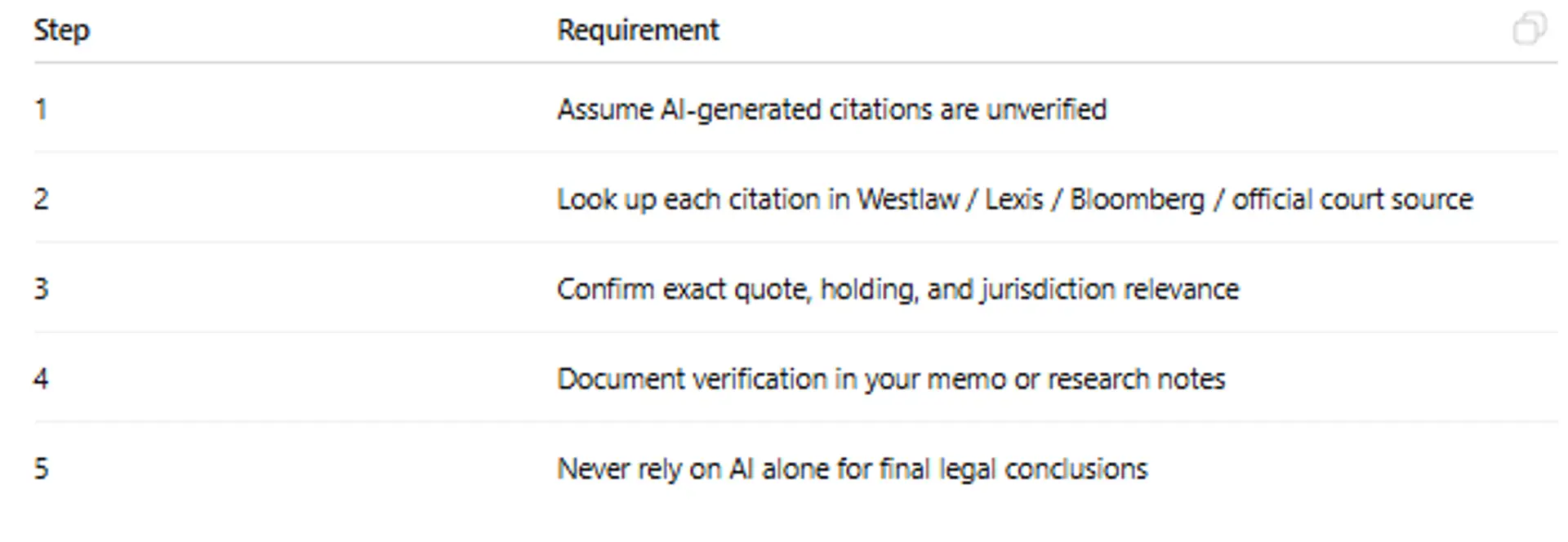
Every case citation, quote, rule reference must be independently verified before relying on it.
5. Example Prompt Frameworks
Issue-Spotting Prompt: You are a legal research assistant. Identify the top legal issues raised by the following facts and explain why they matter. Do not provide case citations yet.
Client-Friendly Explanation Prompt: Explain the legal issue in plain language suitable for a nonlawyer client. Do not oversimplify legal responsibility.
Preliminary Motion Outline Prompt: Provide a structured outline for a Rule 12(b)(6) motion based on these allegations. Identify elements, arguments, and counterarguments in bullet form only.
6. Verification Checklist (Use Every Time)
7. Ethical Guardrails Summary
- Do not input confidential client details into public AI systems.
- Maintain competence regarding the tool’s risks and limitations.
- Supervise all staff use of AI.
- Lawyer remains responsible for all work product.
8.Supplementary Resources
Required Video (Watch):
- ChatGPT For Lawyers — 60 Minute Practical Demonstration” (YouTube)
- ChatGPT Tutorial For Lawyers (For Beginners)
- How To Use ChatGPT Prompts for Lawyers
Lesson Quiz 1.1
Please complete this quiz to check your understanding of the lesson. You must score at least 70% to pass this lesson quiz. This quiz counts toward your final certification progress.
Answer the quiz using the Google Form below.
Click here for Quiz 1.1
Conclusion
This lesson establishes a foundational understanding of what AI and ChatGPT are and how they function within legal practice. AI can significantly enhance efficiency, speed, and clarity in legal workflows. However, it does not replace legal reasoning, ethical obligations, or the lawyer’s responsibility to verify information. The value of AI is determined by how thoughtfully and responsibly the lawyer uses it. In the following lessons, we will learn how to use prompts effectively, avoid inaccurate outputs, and begin applying AI to research and drafting tasks with confidence.
📘 Next and Previous Lesson
Next - Lesson 1.2: Understanding ChatGPT and Legal Use Cases
Related Posts
© 2025 Invastor. All Rights Reserved
User Comments