
All
Ai Content Generator
Ai Picture
Tell Your Story

 InVastor Ai
What HR & Managers Say About AI Restructuring — And How to Have the Conversation That Saves Your Role
What HR & Managers Say About AI Restructuring — And How to Have the Conversation That Saves Your Role
AI isn’t just changing how we work — it’s changing who does what. Across industries, HR leaders and managers are rethinking job roles, skill sets, and even entire departments as automation and AI tools reshape daily operations.
But here’s the truth: most employees aren’t being “replaced” — they’re being restructured. The problem is that many people don’t know how to navigate those conversations about reskilling, reassignments, or AI adoption.
This guide breaks down what HR and managers are really saying behind closed doors — and gives you a step-by-step framework for having the right conversation that protects and even strengthens your role.

What HR & Managers Are Actually Thinking
Based on HR insights from recent reports by Deloitte, McKinsey, and SHRM, three major trends define how leaders are approaching AI restructuring today:
1️⃣ They’re Under Pressure to Modernize Fast
Most HR teams are being told to “adopt AI or fall behind.” This means they’re actively seeking employees who are proactive, adaptive, and willing to reskill. The biggest winners are people who show initiative — not those who wait for formal training to arrive.
Tip: Show curiosity before anxiety. Managers respond far better to “I’d like to learn how to use AI in my role” than to “Is my job safe?”

2️⃣ They’re Prioritizing Skills Over Titles
Job descriptions are being rewritten around skills, not positions. Instead of “Marketing Manager,” the future is “Strategic Content Lead with AI Analytics Proficiency.”
That’s why your focus should shift from protecting a title to expanding your capabilities portfolio.
Tip: List your top 5 daily tasks. Then identify which ones could be automated — and which ones could be upgraded with AI tools. The latter are your growth opportunities.

3️⃣ They Want Employees to Help Lead the Transition
The best employees aren’t just surviving AI transitions — they’re helping shape them. When workers volunteer to pilot new tools or document workflow improvements, HR notices.
Tip: Phrase it like this:
“I’ve been exploring ways to make our reporting process faster using AI — could I test a small pilot next month?”

The Conversation That Saves (and Grows) Your Role
You don’t need to wait for the next performance review to discuss your future. Use this interview-style checklist to guide a productive, professional conversation with your manager or HR partner.
Step 1: Prepare Before You Talk
Do your homework so the conversation feels informed, not defensive.
Checklist:
- Identify 2–3 AI tools that could improve your team’s efficiency.
- Note which parts of your job could evolve — not disappear — with automation.
- Write down how you’ve added measurable value in the past six months.
- Reflect: “If my role changed tomorrow, what new skills would I want to learn?”
Step 2: Open the Conversation Professionally
Here’s a simple script you can adapt word-for-word:
“I’ve been thinking about how AI is changing our workflows, and I want to make sure I’m developing the right skills to stay aligned with where the team is heading. Could we talk about how my role might evolve — and what reskilling opportunities might be available?”
This approach signals initiative, awareness, and partnership — exactly what managers value most.
Step 3: Ask to Be Reskilled or Moved — The Smart Way
Use one of these scripts depending on your situation:
If you want to reskill within your current role:
“I’d like to upskill in [specific area, e.g., data analytics, automation tools]. Could I take a short course or get some hands-on training while continuing my current work?”
If you’re open to shifting roles internally:
“I noticed other teams are experimenting with AI-driven workflows. I’d be very interested in learning from or contributing to one of those projects — even part-time.”
If your current tasks are being automated:
“I understand that automation may affect some of my current responsibilities. Could we explore how I could transition into a new function that aligns with the company’s AI initiatives?”
Each version turns a potential threat into an opportunity — positioning you as adaptable, not replaceable.
Step 4: Close Strong
End with gratitude and clarity:
“Thanks for discussing this — I really want to stay valuable to the team and contribute as our work evolves. What next steps would you recommend for me to start preparing?”
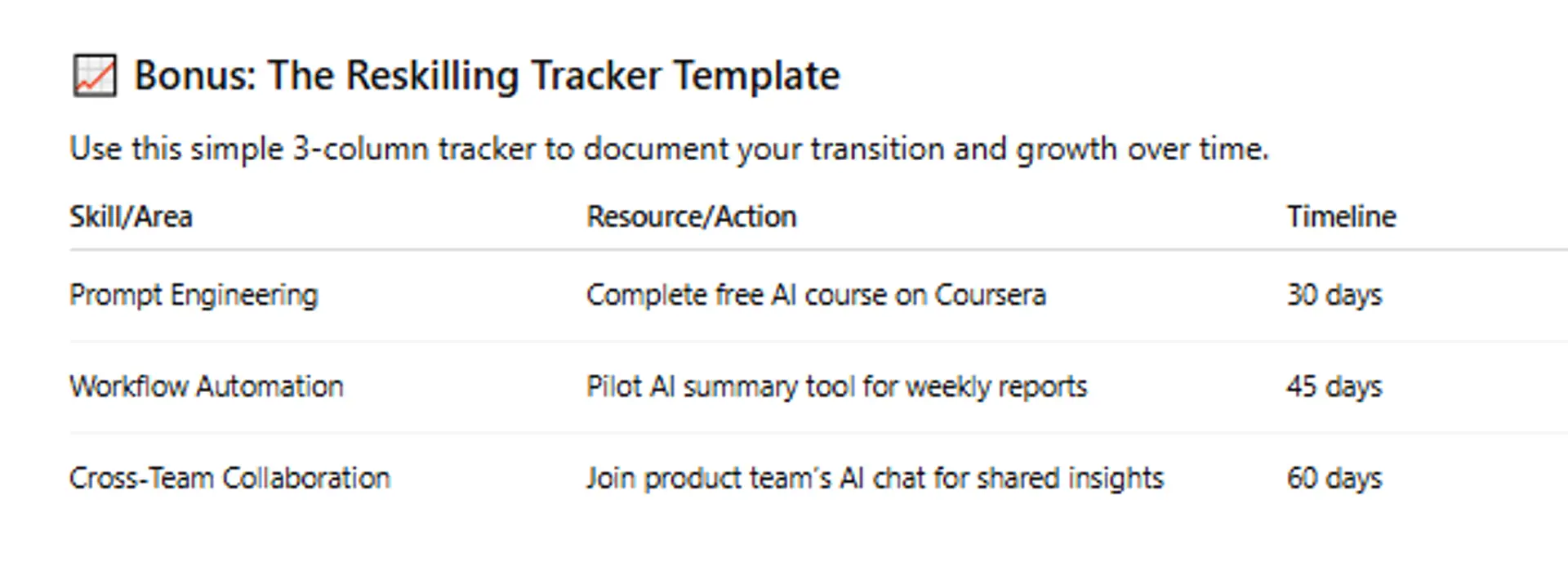
Bonus: The Reskilling Tracker Template
Use this simple 3-column tracker to document your transition and growth over time.
Final Thought: Change the Story
AI restructuring isn’t about replacement — it’s about realignment. HR departments aren’t hunting for who to cut; they’re looking for who can adapt fastest.
Your job isn’t to defend your old role — it’s to define your next one.
Approach the AI conversation not with fear, but with strategy. When you show initiative, curiosity, and a growth mindset, you don’t just survive the restructuring — you help lead it.
Would you like me to write the next article in this “AI Era Productivity” series titled:
Related Posts
© 2025 Invastor. All Rights Reserved
User Comments