
Ai Content Generator
Ai Picture
Tell Your Story

 Ethan Patrick
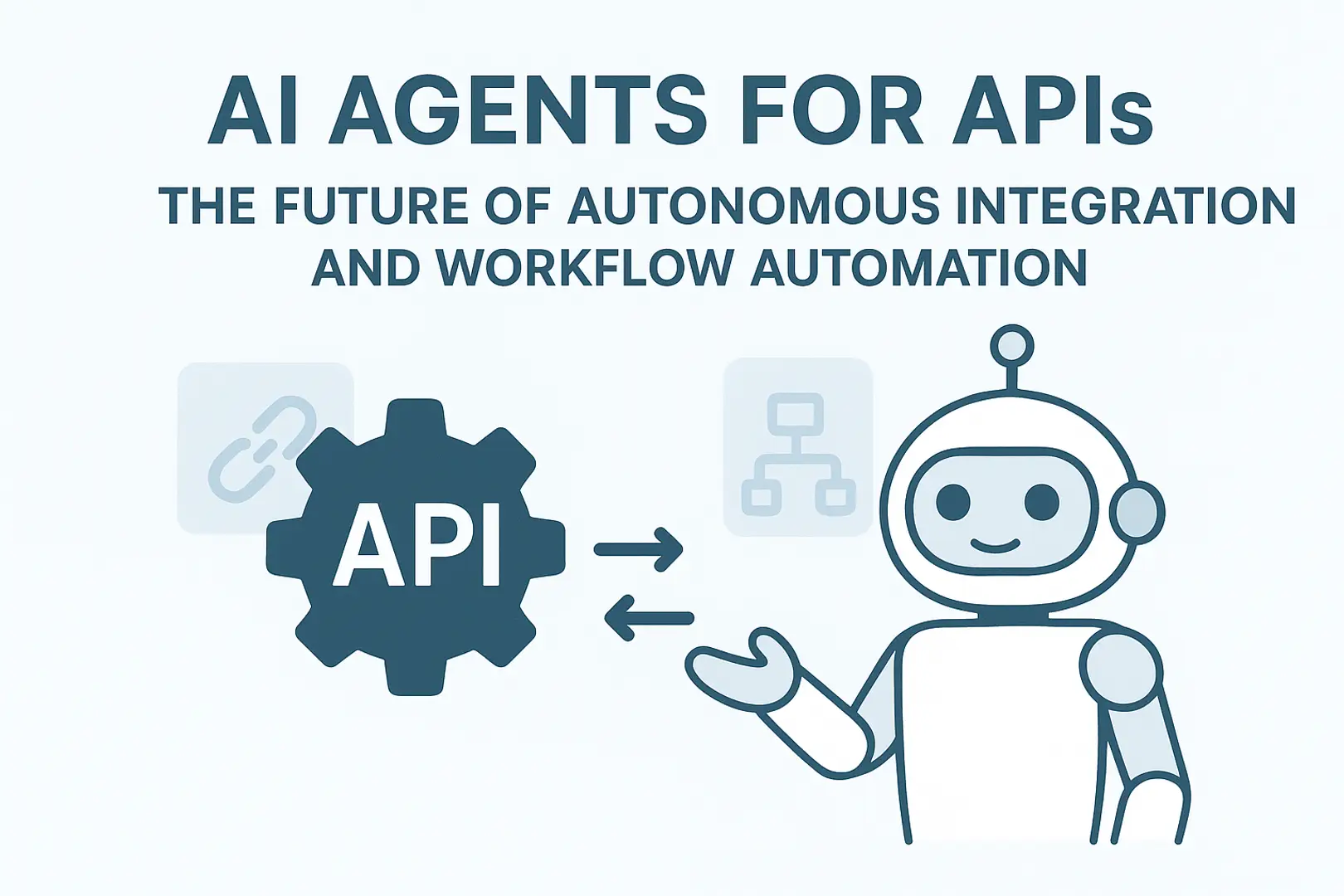
AI Agents for APIs: The Future of Autonomous Integration and Workflow Automation
Application Programming Interface or more commonly known as APIs have taken up the role of silent workhorses of the digital world. They are the invisible threads that connect all our apps and services, letting different services integrate to provide a complete experience. However, our digital ecosystems are scaling at a significant rate, and managing APIs for such enterprises can get complicated. In such situations, we need to ditch the traditional automation systems in place, and adapt with the changing times.
We are talking about AI agents for APIs, which aren’t just minor upgrades from traditional automation agents, but a fundamental shift in how we approach APIs, and reimagining what’s possible.
We are on the cusp of an era where autonomous agents and digital workers can understand our goals and use your APIs as the bridge to take action in the world.
What Exactly Are AI Agents for APIs?
It’s easy to hear “AI” and think of chatbots, but when applied to APIs, the concept is far more functional. It’s about giving software a brain to reason and a voice to act.
Beyond Simple Scripts: Defining the AI Agent
Traditional API interactions used to work when developers would write a script for carrying out a specific task. hire ai developers with understanding of AI agents, as they can build such smart agents that don’t need a specific command. You can provide the agent a goal, it doesn’t follow the textbook, it finds ways to meet the end target.
You could simply command an AI agent to “make a great dinner with whatever is available in the fridge” and it will scan for ingredients, understand the goal, and come up with a plan of action through a sequence of API calls, to fulfill your request.
The Core Components: How They Work
These AI agents function through a continuous loop of perceiving, reasoning, and acting:
Perception:
The agent monitors the digital environment by checking system statuses or reading API responses. It’s how the agent “sees” what’s happening.
Reasoning:
Using Large Language Models (LLMs), the agent takes a user’s goal and breaks it down into a logical plan of which APIs to call and in what order.
Action:
The agent follows the steps in the plan by using your API to perform specific actions, like sending out an email, updating records in the database, or handling whatever tasks are required to complete the job.
The Real-World Impact: Why Should You Care?
This shift from manual coding to goal-oriented agents has profound implications. It’s not just a technical curiosity; it’s a competitive advantage waiting to be unlocked.
From Manual Integration to Autonomous Workflows
Developers spend a huge amount of time, according to a 2023 Postman report, over 10 hours per week on average, stitching APIs together. AI agents promise a future of autonomous workflows. Imagine an agent taking the simple goal “Onboard new employee Jane Doe.” It could then autonomously interact with HR, IT, and payroll APIs to create a profile, provision a laptop, and set up payments without manual intervention.
Creating Hyper-Personalized User Experiences
Generic experiences are fading. In e-commerce, for example, an agent could power a truly dynamic shopping assistant. A customer will be able to ask the agent if they want a durable, waterproof jacket for a hiking trip next month. The AI agent in return would query product APIs, check the weather data, and confirm shipping times to come up with a perfect recommendation.
A forward-thinking Shopify development company can help you build and design such smart stores that feel less catalog oriented, and more like a personal concierge.
Unlocking Business Agility at Scale
When AI agents handle backend tasks, businesses can scale operations without proportionally scaling manpower. Whether you need to sync data across different platforms, or manage real-time updates, agents handle it all. Automation open the door for quicker launches, faster iterations, and leaner teams.
The Challenges and Considerations on the Horizon
Like any transformative technology, the road to adopting autonomous AI for APIs has challenges that require careful planning.
The New Security Conundrum
Giving an AI agent API credentials introduces new security challenges beyond the usual. You must now defend against threats like prompt injection, where a malicious user tricks the agent into performing unintended actions, and tool misuse. Robust systems for authentication, fine-grained authorization (implementing the principle of least privilege), constant monitoring, and strict input validation are non-negotiable. Furthermore, regulations like GDPR and CCPA require strict data handling, demanding transparency in how agents interact with sensitive data.
The Hallucination Problem
LLMs can occasionally “hallucinate,” or generate incorrect information. When an AI agent is controlling critical business processes, a hallucination could lead to booking the wrong flight or deleting the wrong data. Building in “guardrails,” validation checks, and human-in-the-loop approval steps for sensitive operations is crucial to mitigate this risk.
Getting Started: How to Prepare Your APIs for the Agentic Future
You can start preparing for this future now. The readiness of your API infrastructure will directly determine how effectively you can deploy these agents.
Standardize and Document Everything:
Agents thrive on clear, machine-readable documentation. Adopting standards like the OpenAPI Specification with rich semantic descriptions is the first step. This is the contract an agent uses to understand your API’s capabilities.
Design for Predictable Behavior:
An agent needs to trust that your API will behave consistently. Predictable response formats and deterministic behavior are crucial for agents to interact reliably and prevent errors.
Build Composable, Flexible Capabilities:
Design your APIs to be modular, avoiding monolithic designs. Instead of a single rigid endpoint, create smaller, composable endpoints (like /orders/create and /orders/cancel) that an agent can chain together to perform complex workflows.
Implement Intelligent Error Handling:
A simple “404 Not Found” status code isn’t enough for an agent. Your API needs to return clear, informative error messages that help the agent understand why something failed so it can recover or adjust its approach.
Streamline Authentication for Machines:
Human-centric login flows won’t work. Your APIs need frictionless, machine-friendly authentication like OAuth 2.0 or simple API keys to support autonomous access.
Standardizing APIs and Agent Communication
More and more agents are interacting with more APIs, this will again result in an overly complex system, unless a common language is established. Keeping this in mind, there are already established protocols like the Model Context Protocol. It aims to standardize API integration with AI agents, allowing them to discover and interact with any API without custom setups. In the future, such standardization can be extended to Agent-to-Agent or A2A communication.
According to some experts, this can help improve collaboration between different specialized AI agents, for tackling highly complex tasks, creating a true ecosystem of intelligent systems.
Final Words
The rise of using AI agents for APIs is not any other passing trend, it is an indication towards improvising our digital infrastructures. The entire API landscape is undergoing significant growth right now, and SaaS vendors are racing to build “agent-ready” AI solutions.
By building well documented, predictable, and secure APIs, teams are no longer just improving their existing systems, they are setting a foundation for smart agents that will surpass all boundaries for intelligent API automation and innovation.
Related Posts
© 2026 Invastor. All Rights Reserved
User Comments