
Ai Content Generator
Ai Picture
Tell Your Story

 mark nelson
Understanding What Is ECCN?
Anyone involved in exporting technology, software, or sensitive hardware has probably come across the term Export Control Classification Number (ECCN). But what is ECCN exactly, and why is it so critical? In short, ECCNs act as identifiers that show whether an export license is required and help businesses remain compliant with regulations.
This guide explains what an ECCN number is, why it matters, and how companies can determine the right ECCN for their products to avoid compliance risks.Anyone involved in exporting technology, software, or sensitive hardware has probably come across the term Export Control Classification Number (ECCN). But what is ECCN exactly, and why is it so critical? In short, ECCNs act as identifiers that show whether an export license is required and help businesses remain compliant with regulations.
This guide explains what an ECCN number is, why it matters, and how companies can determine the right ECCN for their products to avoid compliance risks.
What Is an ECCN Number?
An ECCN is a five-character alphanumeric code defined under the Export Administration Regulations (EAR). Managed by the Bureau of Industry and Security (BIS), it applies to technology, commodities, and software that may have military or dual-use functions. Unlike tariff or customs codes, an ECCN highlights licensing requirements and possible restrictions for exports. Each ECCN starts with a digit representing product categories (such as electronics or aerospace), followed by a letter that identifies the product group, and three digits that narrow down technical specifications.
Why ECCNs Are Important
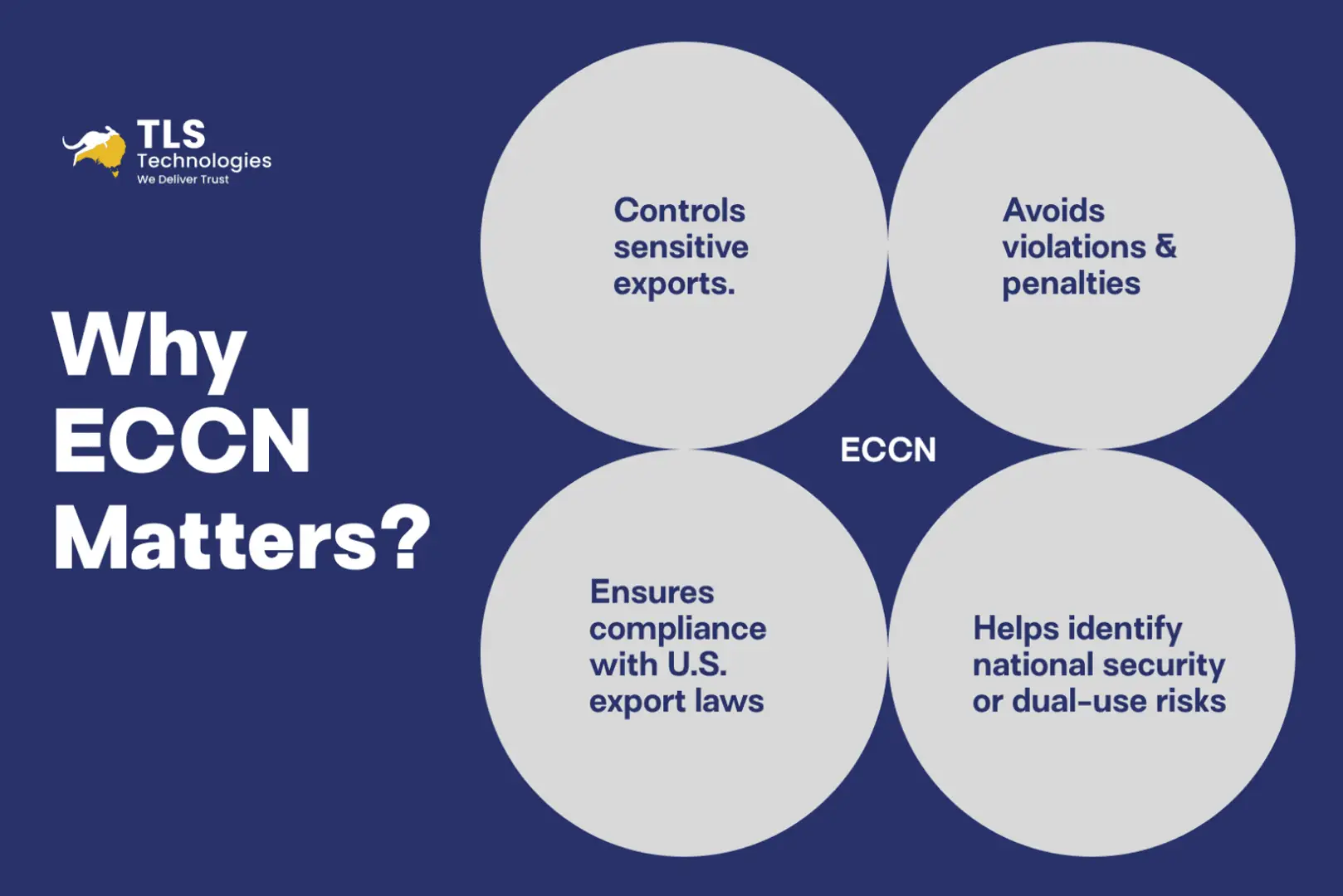
ECCNs safeguard global trade by ensuring sensitive goods don’t leave a country without oversight. They guide exporters on whether a license is needed depending on the product, the buyer, and the destination. Incorrect ECCN classification can cause shipment delays, blocked exports, or even legal penalties.
For example, items tied to encryption, nuclear technology, or aerospace often need strict licensing before export. In contrast, products not listed in the Commerce Control List (CCL) fall under EAR99 and usually don’t require licensing, unless going to restricted regions or end-users.
ECCN vs. Other Codes
It’s easy to confuse ECCNs with Schedule B or HTS codes, but they serve different purposes. ECCNs determine export control and licensing, Schedule B relates to export statistics, and HTS governs import tariffs. Mixing these up can create costly compliance mistakes, so businesses must distinguish them clearly.
How to Identify an ECCN
There are three main ways to classify an item:
- Check with the original manufacturer, who often knows the ECCN.
- Conduct self-classification by reviewing the CCL index and matching technical features with code descriptions.
- Submit a formal classification request through BIS (SNAP-R), which gives an official determination.
Self-classification can be fast if the product’s specs are clear, while official BIS rulings may take weeks but provide certainty.
Licensing Impact
Once the ECCN is known, companies can determine licensing requirements using the Commerce Country Chart. Sensitive categories nearly always require a license, while EAR99 products are typically license-free unless shipped to embargoed destinations.
Who Should Know Their ECCN?
Manufacturers, distributors, and exporters dealing with electronics, high-tech hardware, defense items, or encryption software all need ECCN classification. Even shipments passing through multiple countries (transshipment) may need proper ECCN tagging.
Common Misconceptions
Some assume ECCNs only apply to military goods, but commercial technology, such as telecom devices or advanced sensors—may also be restricted. Another myth is that EAR99 items never need licenses, but this depends on where and to whom they’re shipped.
Risks of Misclassification
Exporting under the wrong ECCN can trigger fines, revocation of trade privileges, shipment seizures, or legal action. For industries handling dual-use or sensitive goods, accurate classification is essential, not optional.
ECCN in Practice
Imagine exporting a drone with built-in encryption. Classified under ECCN 5A992, it may require a license depending on its destination. Correct classification not only prevents delays but also ensures smooth customs clearance.
Tips for Accuracy
Always verify technical data with the manufacturer, carefully cross-check against the CCL, and if in doubt, pursue a BIS ruling. Shortcuts in classification may lead to major setbacks later.
ECCN as a Competitive Advantage
Beyond compliance, ECCNs can be leveraged strategically. Companies that manage classification properly open doors to new markets, build stronger supply chains, and avoid regulatory risks.
Final Thoughts
Understanding what is ECCN is essential for exporters handling advanced technology, software, or dual-use products. Getting the classification right reduces compliance risks and ensures smooth global trade.
For organizations looking to simplify compliance, TLS Technologies provides global trade expertise, including IOR and EOR solutions and technology hardware importer of record services that help businesses manage licensing, customs, and cross-border logistics efficiently.
Related Posts
© 2025 Invastor. All Rights Reserved
User Comments