
Ai Content Generator
Ai Picture
Tell Your Story

 John Peter
Data Mesh vs Data Fabric: Which Shapes the Future?
Introduction
As data volumes scale and AI adoption accelerates, enterprises face a critical challenge: how to organize, govern, and deliver data efficiently across complex ecosystems. Traditional centralized architectures struggle under the weight of distributed teams, diverse data sources, and constantly shifting business needs.
Two architectural paradigms—Data Mesh and Data Fabric—have emerged to address these challenges. While often used interchangeably, they represent distinct philosophies for managing enterprise data at scale. Understanding their differences, overlaps, and future trajectories is essential for building resilient, AI-ready infrastructures.
What Is a Data Mesh?
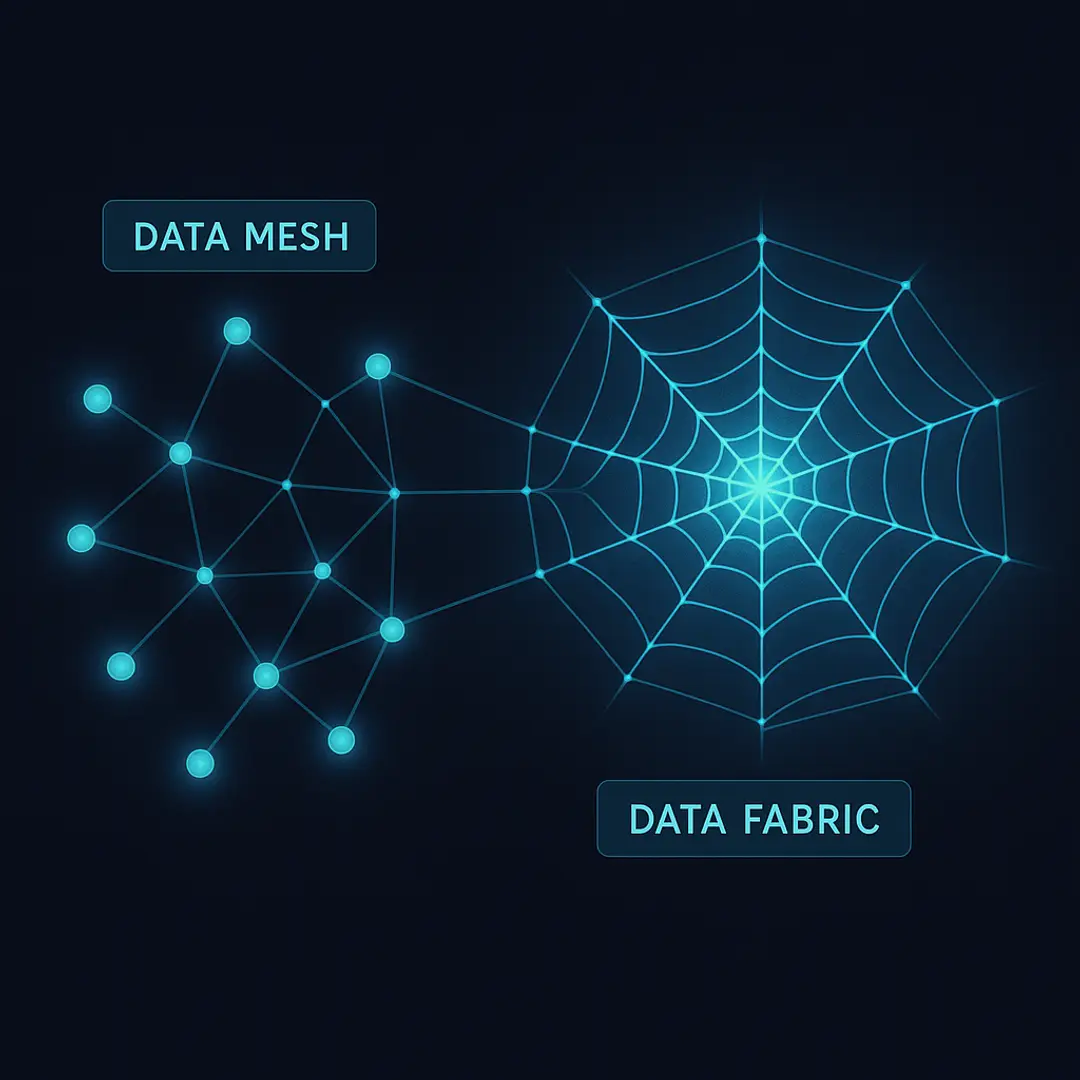
Data Mesh shifts the paradigm from centralization to decentralization. Instead of treating data as a monolithic asset controlled by one team, it distributes ownership to domain experts.
Core principles of Data Mesh:
- Domain ownership – Data is managed by the teams closest to it, ensuring accuracy and relevance.
- Data as a product – Each dataset is treated like a product with defined SLAs, quality metrics, and user documentation.
- Self-serve infrastructure – Teams access standardized platforms that reduce dependency on centralized IT.
- Federated governance – Shared policies ensure compliance without stifling autonomy.
Key takeaway: Data Mesh empowers domain teams to treat data as a strategic asset, fostering agility and accountability.
What Is a Data Fabric?
Data Fabric emphasizes a unified, intelligent layer that connects disparate sources across the enterprise. It relies heavily on metadata, AI, and knowledge graphs to provide a single semantic layer of data access and governance.
Core features of Data Fabric:
- Metadata-driven intelligence – Automated discovery, classification, and lineage tracking.
- Unified access – A consistent view across lakes, warehouses, APIs, and SaaS platforms.
- AI-powered automation – Machine learning assists in integration, transformation, and monitoring.
- Embedded governance – Security, privacy, and compliance applied seamlessly across systems.
Key takeaway: Data Fabric reduces complexity by providing an AI-enhanced connective tissue across fragmented environments.
Data Mesh vs Data Fabric: Contrasting Approaches
While both address enterprise data sprawl, they solve different problems.
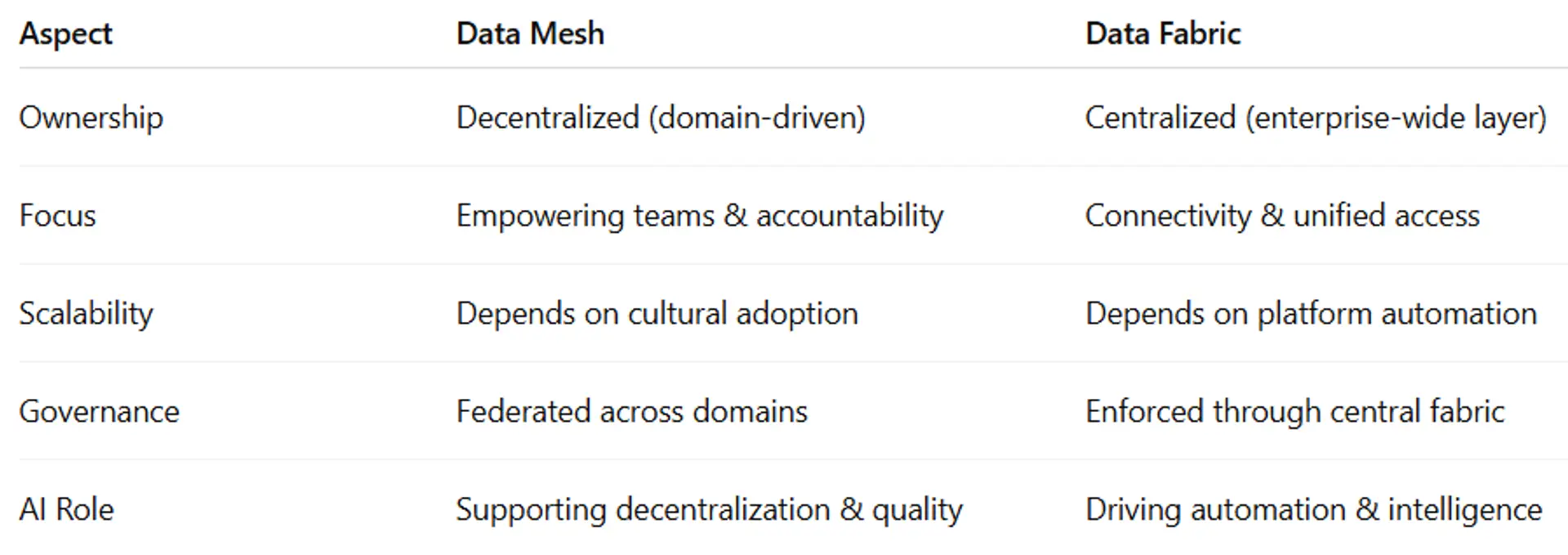
Practical reality: Enterprises often blend both approaches—using Data Fabric for interoperability and governance, and Data Mesh for distributed ownership and innovation.
Where Does This Fit in the Evolution of Data Workflows?
The rise of Data Mesh and Data Fabric builds on earlier innovations in ETL, ELT, and AutoML. Just as those technologies streamlined ingestion and machine learning, these newer paradigms tackle the organizational and governance bottlenecks.
For a deeper dive into that evolutionary path—from ETL to AutoML—see the detailed breakdown here: From ETL to AutoML – How Data Workflows Are Becoming Smarter and Faster.
Future Outlook: 2025 and Beyond
The next phase of enterprise data architectures will likely feature:
Hybrid adoption – Most organizations will combine Mesh and Fabric principles.
Agentic AI governance – Autonomous AI agents monitoring compliance and lineage.
Composable data ecosystems – Reusable domain datasets packaged as API-first products.
Real-time semantic fabrics – Extending metadata-driven intelligence into streaming pipelines.
Key takeaway: The future is not Mesh or Fabric—it is Mesh and Fabric, working together to balance autonomy with enterprise-wide intelligence.
Conclusion
As enterprises scale their AI ambitions, the choice between Data Mesh and Data Fabric is not binary. Both represent essential strategies for building resilient, adaptable data architectures. Organizations that can harmonize these approaches will unlock faster innovation, stronger governance, and greater business agility.
Pangaea X enables this evolution by connecting enterprises with freelance data strategists, architects, and engineers who specialize in modern data infrastructures—helping organizations adopt the right balance of Mesh and Fabric for their future.
Related Posts
© 2025 Invastor. All Rights Reserved
User Comments