
Ai Content Generator
Ai Picture
Tell Your Story

 Lisa Joli
How Has UWB Technology Revolutionized Asset Tracking?
It is very important to track assets quickly and reliably in the current rapid business world. The use of Ultra-Wideband (UWB) technology is making it easier for industries to keep track of valuable goods with high accuracy, little delay, and strong security.
For its part, UWB is superior to RFID or Bluetooth in providing very accurate results, making it excellent for many uses such as warehouses and healthcare management of assets. This blog details UWB’s operations, looks at its uses across different industries, highlights its main advantages, and includes guidance for a good implementation. Look for the best RFID inventory software when you have installed the system in your shop.
Basics of UWB Technology
a. Ultra-Wideband (UWB) works by using high-frequency radio in a wide range, generally between 3.1 and 10.6 GHz.
b. In contrast to Wi-Fi or Bluetooth, which work only on a slim band, UWB uses low-power pulses that spread across a wide spectrum.
c. For this reason, industries that need to follow and track their assets can use it, because it offers high accuracy, works without hindrance in busy radio areas, high data transfer, and secure information transfer.
Use of UWB in Asset Tracking
Fixed receivers, called anchors, and movable tags connected to devices are used by UWB tracking systems. By using ToF, such systems can track the locations of devices reliably and accurately in different areas in real time.
Diverse Use of UWB in Asset Tracking
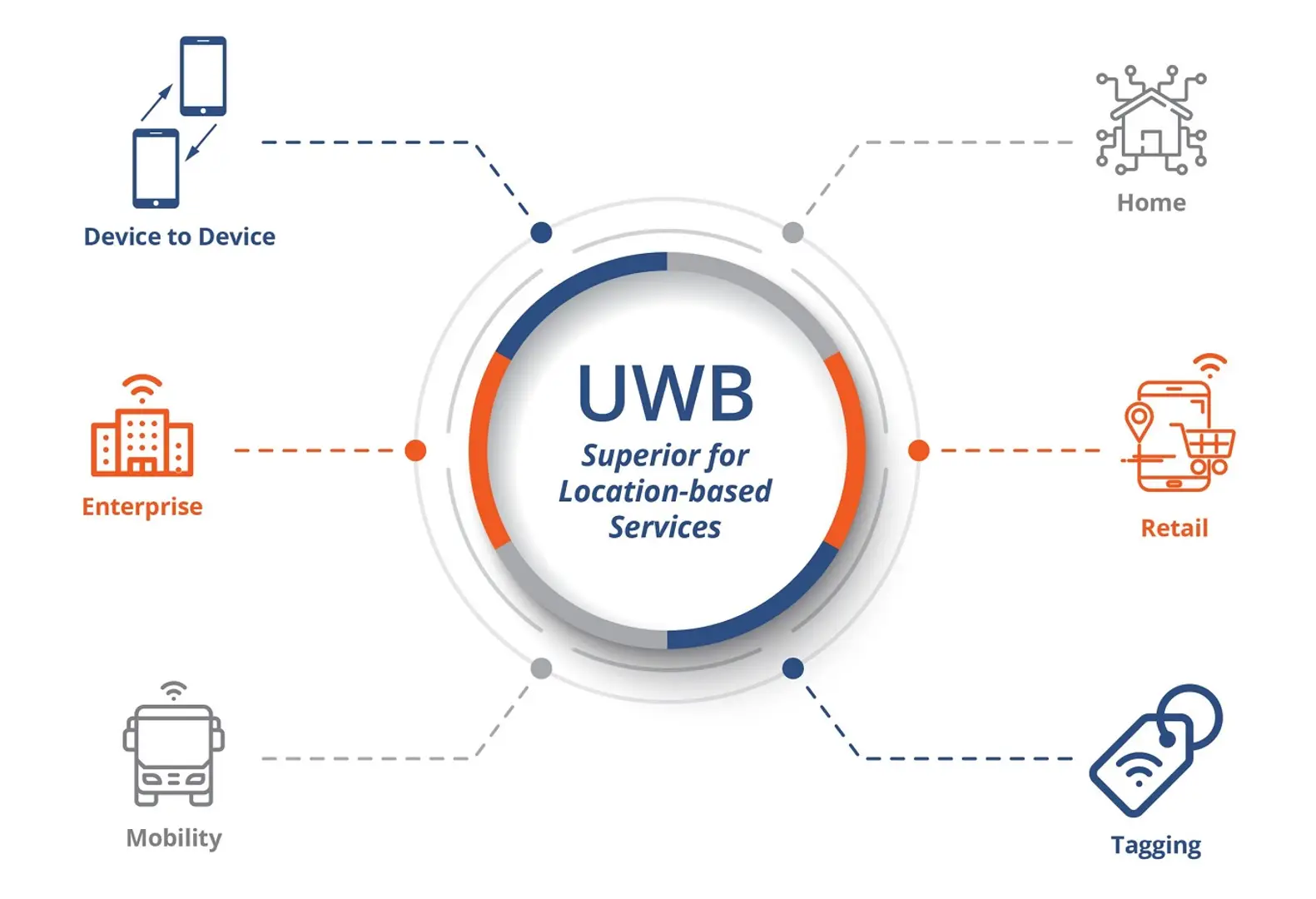
Here are some most important segments where we can use UWB technology and get excellent outcomes.
a. Warehouse Management
Because UWB lets users track pallets and goods in real time, less cargo gets lost, and things in the logistics chain run more smoothly. It aids in using smart forklifts for safe movements and helps increase efficiency by auditing the warehouse’s inventory without requiring workers to check everything manually.
b. In the Healthcare Industry
With UWB technology, it is possible for hospitals to monitor IV pumps and defibrillators instantly. It contributes to patients’ and workers’ safety by offering live tracking, ensuring spacing between individuals, and sending emergency signals quickly, which boosts health services and reaction time.
c. Industrial Use
UWB systems keep an eye on tools and equipment to avoid them getting lost and using them efficiently. Using this, accidents in hazardous zones are prevented since personnel are detected and real-time alarms are sent to colleagues.
d. In Retail Shops
Thanks to UWB, payment can be done without having to touch any device, and experiences are personalized in stores. It also makes it easier for visitors to find their way in big places such as airports, malls, and office buildings by showing them real-time directions for their location. RFID retail tracking works similarly, so choose carefully.
Ultimate Reasons for Choosing UWB Technology
- When it comes to accuracy, UWB is the best, being able to locate items within just 10–30 cm, much more precise than GPS or RFID.
- It offers quick updates, holds strong security, and is impervious to jamming or faked signals.
- UWB tags use less energy and still work correctly in demanding environments with many metal structures or high radio waves.
- Once you start using UWB, you will learn many more interesting aspects of this technology.
Related Posts
© 2025 Invastor. All Rights Reserved
User Comments