
Ai Content Generator
Ai Picture
Tell Your Story

 jasonroyr021 jasonroyr021
A Collector’s Guide to the Rolex Milgauss: Models, Features, and Value
The Rolex Milgauss is one of the most distinctive and technically innovative watches in the Rolex lineup. Originally designed for scientists and engineers working in high-magnetic environments, it has evolved into a cult favorite among collectors. With its unique design, anti-magnetic properties, and bold aesthetic, the Rolex Milgauss is unlike any other Rolex model.
This guide explores the history, key features, notable models, and value of the Rolex Milgauss, helping collectors understand why this watch holds a special place in horology.
The Origins of the Rolex Milgauss
The Rolex Milgauss was introduced in 1956 as a response to the growing demand for a watch that could withstand strong magnetic fields. Scientists, engineers, and medical professionals working in environments with high electromagnetic interference often found that traditional mechanical watches became unreliable. Rolex addressed this issue by designing a watch capable of resisting magnetic fields up to 1,000 gauss (hence the name “Milgauss,” derived from the French words “mille” meaning thousand and “gauss,” a unit of magnetic measurement).
With an inner Faraday cage that shielded the movement from magnetic interference, the Rolex Milgauss became an essential tool for professionals at institutions like CERN (the European Organization for Nuclear Research). Despite its groundbreaking technology, early models did not achieve widespread commercial success, making vintage pieces rare and highly sought after by collectors today.
Key Features of the Rolex Milgauss
What sets the Rolex Milgauss apart from other Rolex models is its combination of scientific utility and striking design. Key features include:
Anti-Magnetic Shielding: The defining characteristic of the Rolex Milgauss is its ability to resist magnetic fields up to 1,000 gauss, thanks to an internal Faraday cage made of soft iron.
Unique Lightning Bolt Seconds Hand: One of the most distinctive design elements of the Rolex Milgauss is its lightning bolt-shaped seconds hand, a nod to its scientific heritage.
Green Sapphire Crystal: Modern iterations of the Rolex Milgauss feature a unique green-tinted sapphire crystal, making it the only Rolex model with this characteristic.
Stainless Steel Case and Bracelet: Unlike many Rolex models available in various metals, the Rolex Milgauss has always been crafted in stainless steel, emphasizing its professional tool-watch identity.
Automatic Movement: Powered by Rolex’s in-house automatic movements, the Rolex Milgauss ensures precise timekeeping while maintaining resistance to external magnetic forces.
Notable Rolex Milgauss Models
Over the decades, the Rolex Milgauss has undergone several transformations. Some of the most significant models include:
Rolex Milgauss Reference 6541 (1956)
The first-generation Rolex Milgauss, Reference 6541, was released in the 1950s. It featured a rotating bezel similar to the Rolex Submariner and a black honeycomb dial. Today, this vintage model is exceptionally rare and highly valuable among collectors.
Rolex Milgauss Reference 1019 (1960s-1980s)
This version introduced a more subdued design, removing the rotating bezel in favor of a smooth stainless steel bezel. It was available in black and silver dials with stick hour markers. While it was produced for over two decades, it was discontinued in the late 1980s due to limited demand, further increasing its desirability among vintage watch enthusiasts.
Rolex Milgauss Reference 116400 (2007-2014)
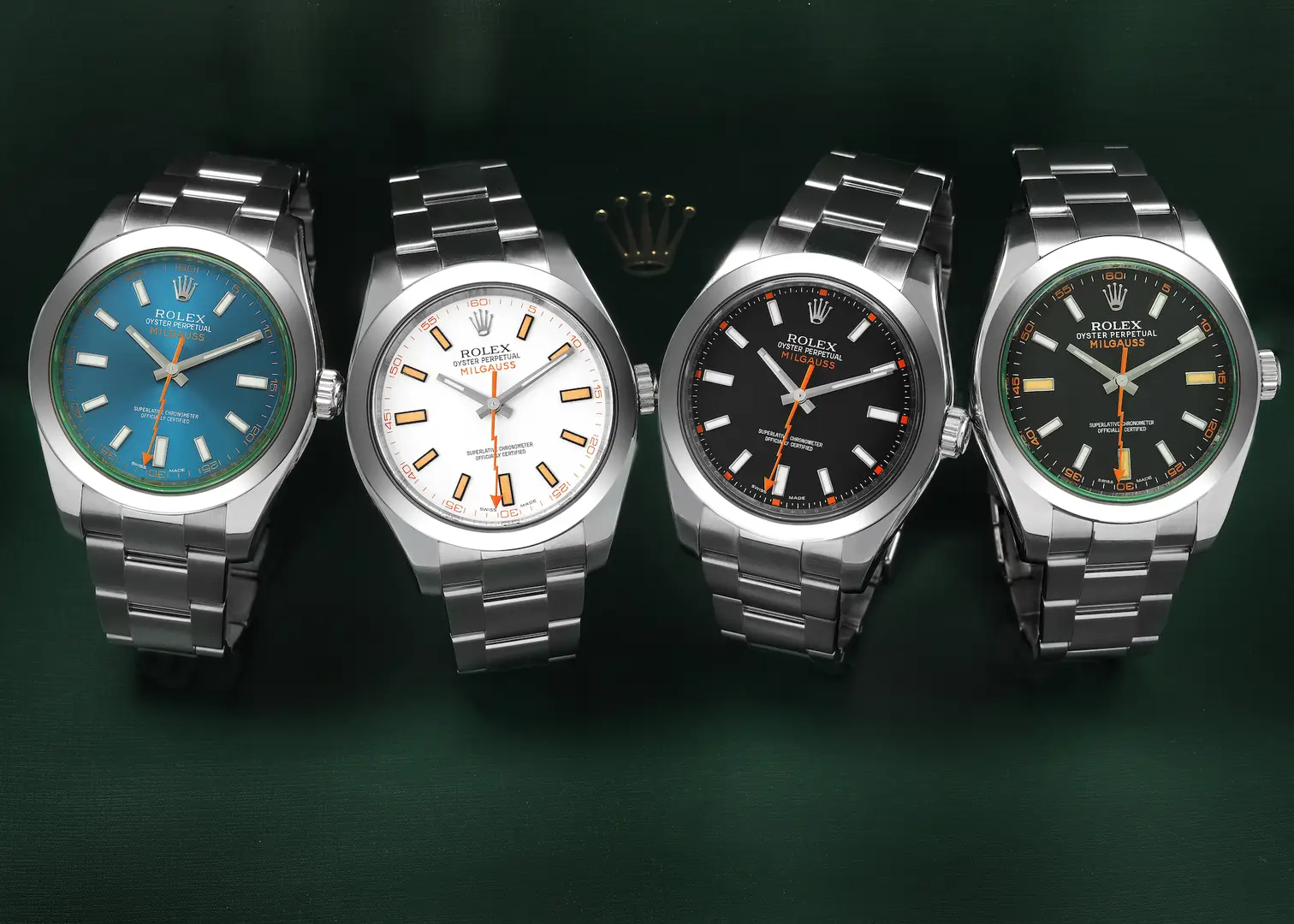
After being absent from Rolex’s catalog for nearly two decades, the Rolex Milgauss made a comeback in 2007 with Reference 116400. This model revived the signature lightning bolt seconds hand and introduced a green sapphire crystal (GV, or “Glace Verte”), which remains exclusive to the Rolex Milgauss. It was released with black, white, and GV dial variants.
Rolex Milgauss Reference 116400GV (2014-Present)
The most recent iteration of the Rolex Milgauss continues to feature the green sapphire crystal, an orange lightning bolt seconds hand, and a combination of modern Rolex advancements, including the Parachrom hairspring for added magnetic resistance. The blue “Z-Blue” dial variant introduced in 2014 has become particularly popular among collectors.
The Value and Collectibility of the Rolex Milgauss
The Rolex Milgauss has historically been an underrated model, but its collectibility and value have surged in recent years. Several factors contribute to its increasing desirability:
Rarity of Vintage Models: Early Rolex Milgauss models, such as the Reference 6541 and Reference 1019, are extremely rare. Well-preserved examples command high prices at auctions.
Unique Design Features: The green sapphire crystal, lightning bolt seconds hand, and scientific background make the Rolex Milgauss stand out from other Rolex watches.
Long-Term Investment Potential: While not as expensive as Rolex sports models like the Daytona or Submariner, the Rolex Milgauss has shown steady appreciation in the secondary market.
Limited Availability: With Rolex’s strict production controls and high demand for sports models, finding a Rolex Milgauss at retail can be challenging, further driving up resale values.
Wrapping Up
The Rolex Milgauss is a unique and historically significant watch that appeals to both watch enthusiasts and serious collectors. Its blend of scientific innovation, bold aesthetics, and distinctive features make it a standout piece in the Rolex lineup. Whether acquiring a vintage reference or a modern version, owning a Rolex Milgauss is not just about wearing a luxury watch—it is about possessing a piece of horological history.
For those looking to invest in a Rolex Milgauss, understanding its models, features, and value trends is essential. As appreciation for this underrated Rolex continues to grow, it remains one of the most intriguing and collectible timepieces in the world of luxury watches.
Related Posts
© 2025 Invastor. All Rights Reserved
User Comments