
Ai Content Generator
Ai Picture
Tell Your Story

 Manav Kapoor
Implementing Machine Learning Algorithms in Laravel Applications
Hey folks! 🚀 Laravel is already a powerful PHP framework, but adding machine learning (ML) to the mix takes it to a whole new level. Imagine Laravel applications making intelligent decisions, automating tasks, and enhancing user experiences without manual intervention. In this guide, I’ll show you how to integrate ML into Laravel applications, step by step.
Why Machine Learning is Important for Laravel Applications
Machine learning brings automation and intelligence to Laravel applications, making them smarter and more efficient. Instead of relying on traditional rule-based logic, ML enables applications to analyze data, recognize patterns, and make predictions. This improves everything from user experience to security.
Some common use cases include:
Recommendation Systems 🎯 – Think of Netflix suggesting movies or Amazon recommending products. Laravel developers can use ML to offer personalized content based on user behavior.
Fraud Detection 🔍 – Banks and e-commerce platforms use ML to detect fraudulent transactions in real time. A Laravel development company can integrate ML models to analyze transaction patterns and flag suspicious activities.
Chatbots & Virtual Assistants 🤖 – AI-driven chatbots enhance customer support by responding instantly, improving engagement, and reducing support costs. Laravel can integrate NLP-based chatbots for a seamless experience.
How Laravel Can Integrate Machine Learning Models
Laravel can integrate ML models in multiple ways, making it easy to bring AI-powered features into PHP applications.
Using APIs & External ML Services 🌎 – Laravel can connect to machine learning platforms like TensorFlow.js, PyTorch, or OpenAI via APIs. These external models handle data processing, and Laravel fetches the predictions.
Leveraging Laravel AI Packages 📦 – Laravel packages like Laravel AI simplify integrating AI-powered features. PHP-based ML libraries like Rubix ML also allow running models directly in Laravel without relying on external services.
Choosing the Right Machine Learning Algorithm for Laravel
When integrating ML into Laravel applications, choosing the right algorithm is crucial.
Supervised Learning 🏆 – Uses labeled data to make predictions. Great for fraud detection, email spam classification, and sentiment analysis. Example: Decision Trees, Support Vector Machines.
Unsupervised Learning 🧩 – Identifies hidden patterns in data without labeled examples. Perfect for recommendation engines and customer segmentation. Example: K-Means Clustering, Principal Component Analysis.
Reinforcement Learning 🎮 – Learns by trial and error, commonly used in game development and robotics. Example: Q-learning, Deep Q-Networks.
Setting Up a Laravel Project for Machine Learning
To integrate ML models into a Laravel project, you’ll often need a backend Python-based model running alongside Laravel. Here’s how to set it up:
Use Flask or FastAPI for ML Models 🐍 – These Python frameworks allow you to create REST APIs for machine learning models. Train an ML model in Python, then expose it via an API endpoint.
Connect Laravel to the ML API 🔗 – Laravel uses HTTP clients like Guzzle or Laravel HTTP to send requests to the ML model and receive predictions.
Install Dependencies 📦 – In Laravel, install Guzzle (composer require guzzlehttp/guzzle) to communicate with the ML service. In Python, install Flask (pip install flask) or FastAPI (pip install fastapi).
Implementing a Laravel-Based Recommendation System
Let’s build a simple recommendation engine in Laravel using collaborative filtering, which suggests content based on user preferences.
Train an ML model in Python 🎓 – Use scikit-learn or TensorFlow to build a collaborative filtering model that predicts user preferences.
Expose an API Endpoint 🌍 – Create a Flask API that receives a user ID and returns recommendations.
Connect Laravel to the API 🔌 – In Laravel, use the Http facade to fetch recommendations.
Display Recommendations 🎥 – Render the recommendations dynamically on the frontend.
Using AI Chatbots in Laravel Applications
AI-powered chatbots transform how businesses interact with users. Laravel can integrate Dialogflow, IBM Watson, or OpenAI’s GPT models for automated conversations.
Use Dialogflow for NLP 🗣️ – Train a Dialogflow bot to understand user queries.
Connect Laravel to Dialogflow API 🔗 – Send user messages to the bot and fetch responses via API.
Embed in Laravel Chat 💬 – Integrate the chatbot into Laravel-based messaging systems to provide instant support.
Deploying Machine Learning Models in Laravel
Once your ML model is ready, deploying it efficiently is key. Here are some options:
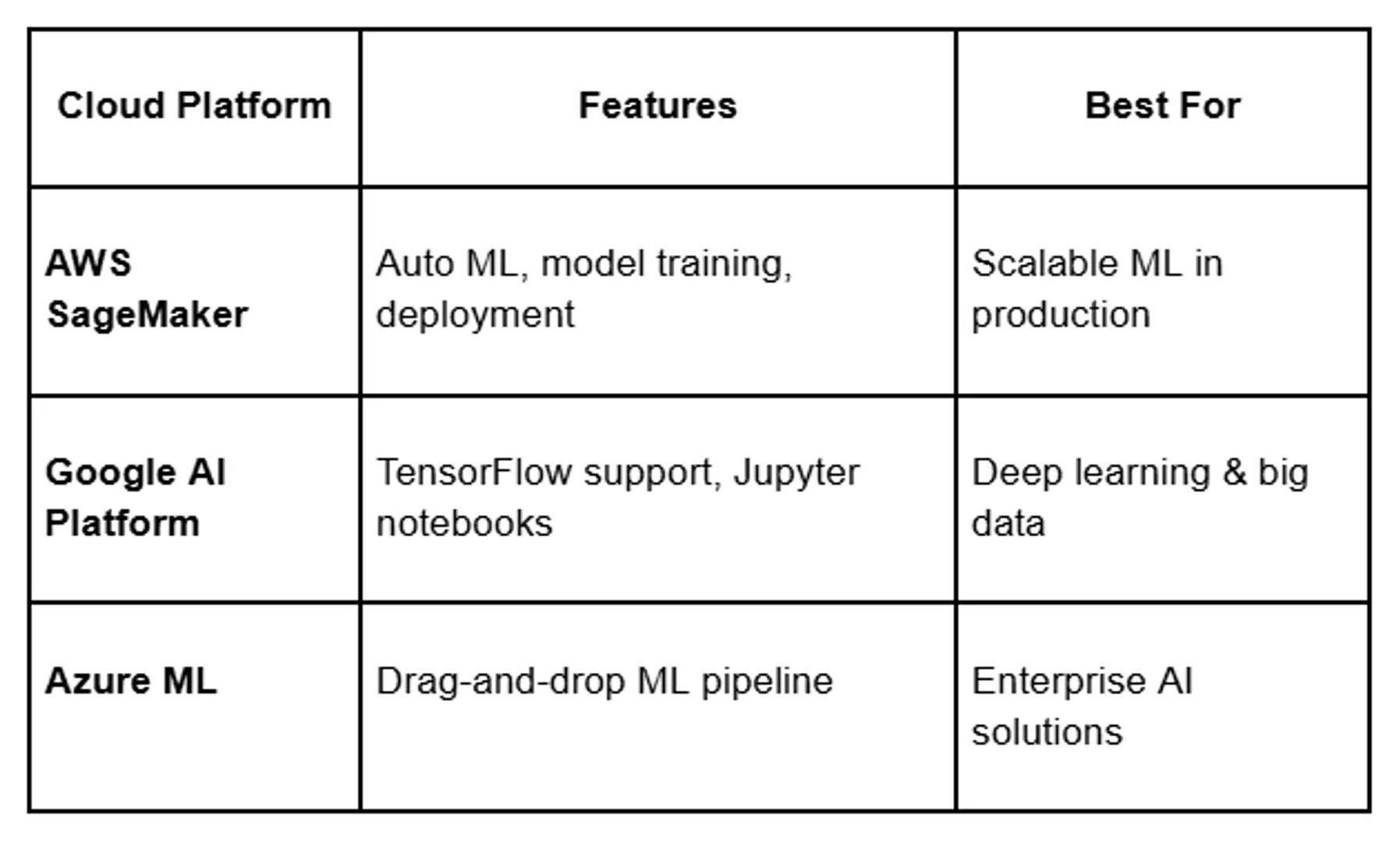
Laravel development services can integrate these platforms via API calls, making it easy to add AI-powered features.
Optimizing Performance of ML-Powered Laravel Applications
Machine learning models can be resource-intensive. Here’s how to optimize performance:
Caching Results 🏎️ – Store ML predictions in Redis or Memcached to reduce API calls.
Queue Processing ⏳ – Use Laravel’s queues (Redis, RabbitMQ) to handle ML tasks asynchronously.
Database Indexing 📊 – Optimize database queries to ensure efficient storage and retrieval of ML-generated data.
Final Thoughts
Machine learning is a game-changer for Laravel applications, adding automation, intelligence, and personalization. By integrating ML models via APIs, using Laravel AI packages, and deploying on cloud platforms, you can build smarter applications that deliver data-driven experiences.
I encourage you to experiment with AI-powered features in your Laravel projects. Whether it’s chatbots, recommendation systems, or fraud detection, ML unlocks endless possibilities for innovation.
Key Takeaways
Machine learning enhances Laravel apps with intelligent features.
Laravel can integrate ML models via APIs or native PHP implementations.
Cloud platforms like AWS, Google AI, and Azure simplify ML model deployment.
Frequently Asked Questions (FAQs)
Can Laravel run machine learning models natively?
Laravel itself doesn’t provide built-in ML capabilities, but it can integrate with PHP-based ML libraries like Rubix ML or call external ML models via APIs. The best approach depends on the complexity of the ML task.
What is the best way to integrate AI in Laravel?
The most effective way is to connect Laravel to external ML APIs such as TensorFlow, OpenAI, or AWS SageMaker. Alternatively, you can use Laravel AI packages to run ML models within PHP.
How can I use Python ML models with Laravel?
You can run ML models in Python using Flask or FastAPI and expose them as REST APIs. Laravel can then call these APIs to fetch predictions and process results.
What are common AI use cases in Laravel applications?
Common use cases include chatbots, fraud detection, recommendation engines, sentiment analysis, and automated customer support. AI helps improve efficiency, security, and user experience in Laravel applications.
Is machine learning in Laravel resource-intensive?
It depends on the complexity of the model. Simple models running within Laravel are lightweight, but deep learning models require GPU-based cloud solutions for efficient processing. Using caching and queue systems can help manage resource usage.
That’s it, folks! 🚀 Machine learning is the future, and Laravel web development services are at the forefront of innovation. Try integrating AI-powered features into your Laravel project—you’ll be amazed at what’s possible!
Related Posts
© 2025 Invastor. All Rights Reserved
User Comments